Hummingbirds' Guide to Always-On UGC Strategy

Hummingbirds is built for creator-powered retail activations—helping brands win attention where shoppers actually decide.

01

The Case for Always-On

What moves a shopper faster: a single viral post, or the fifth time a friend has mentioned a product this year?

Most CPG brands still treat creator content as a campaign. A launch happens, a burst of activity follows, then the program goes quiet until the next big moment justifies starting over. Every restart means resourcing from zero: new creators to find, new briefs to write, new content to produce, new proof to build for the next retail buyer meeting. Worse, algorithms reward what's new and relevant over what's already proven, even when the older content is still strong. And producing content is only half the job. A buyer isn't won over by content alone. They want proof of how it reached shoppers and moved product, which is a distribution challenge in its own right (more on that in the Distribution section below).

That leaves two kinds of brands underserved, and it's worth figuring out which one describes you.

Haven't started yet?

You're probably waiting for the "right" launch to justify getting creators involved, instead of building the muscle now.

Already running campaigns?

You likely have real proof that a single push works, but no system for making it compound. A back-to-school campaign performs, the team moves on, and by next quarter you're sourcing creators from scratch again instead of building on what already worked.

What that costs in practice:

  • Re-recruiting and re-briefing creators every time, instead of building on relationships that already know the brand
  • Momentum that resets the moment support pauses — as one brand's team put it after stepping back between campaigns, the results were fine while the program ran, but they didn't see sustained retail momentum once support wasn't continuous
  • Launch windows missed entirely because planning didn't start until the moment was already close
  • Expecting a single campaign to prove awareness, content quality, engagement, and sales ROI all at once, instead of building each piece over time
  • Going dark between tentpole moments even though the product is still sitting on shelf the whole time

Retail doesn't run on a single moment. A buyer resets the test every month. A new door opens on its own timeline. A category has its own calendar of highs and lows that has nothing to do with a brand's launch date. Word of mouth, to function as a real growth channel and not a lucky break, has to run on the same continuous timeline retail does.

"Winning brands show up consistently across multiple consumer contexts."

This guide maps that timeline: the seasonal moments and retail milestones — product launches, shelf resets, distribution expansions — that come up every year for a CPG brand, and how creator content and Offers work together across all of them as one compounding system instead of unrelated bursts. Marketing gets the proof layer it's been missing. Sales gets a channel that keeps producing verified trial between buyer meetings, not just around them.

"Our sales team and retail partners kept asking the same thing: what are we actually doing to support them? Hummingbirds was the first partner that let us actually answer that, retailer by retailer."

Halee Sanchez

Sr. Social Media Manager, OLLY

"Hummingbirds is something we can bring straight into a buyer meeting and watch people who have never worked in marketing lean in and ask what it is. Buyers get genuinely curious, and it shows them exactly how much marketing support is behind our products in their stores. That is not something we get from any other part of our marketing mix."

Katelyn Weaver

Marketing and Sales Specialist, Yes! Apples

"Hummingbirds helps us generate authentic creator content at a scale that's difficult to achieve through traditional influencer programs. We activate retailers like Target and Costco while creating content that works across our social channels long after a campaign ends."

Heidi Mika

Director of Influencer Marketing, Banza

"Hummingbirds has been one of the most authentic ways we've found to build local awareness. Their creators aren't influencers posting for reach, they're everyday people who actually buy and talk about products in their communities."

Anna Valenti

Director of Brand Partnerships & Culture, Slate Milk

"Hummingbirds has helped us introduce our brand to customers in new markets. Having creators authentically share our products with their audiences has been instrumental in driving trial and awareness. The platform makes it easy to activate and manage campaigns, and the team has been great to work with."

02

The Always-On Calendar: Seasonal Moments and Retail Milestones Compound

Two different things drive when a brand should be activating creators, and most brands only plan for one.

The first is the seasonal and cultural calendar every shopper already lives on: New Year's, Valentine's Day, Mother's Day, back-to-school, Halloween, the holidays. These are predictable, they repeat every year, and consumer intent is already high before a brand does anything.

The second is a brand's own retail calendar: a product launch, a new door opening, a shelf reset, a distribution expansion into a new region or banner. These are brand-specific and don't wait for a holiday to justify creator support. A retailer doesn't care that a launch happens to land in March instead of November — it still needs proof of demand.

An always-on program plans for both at once. Here's what that looks like across a single year for one brand:

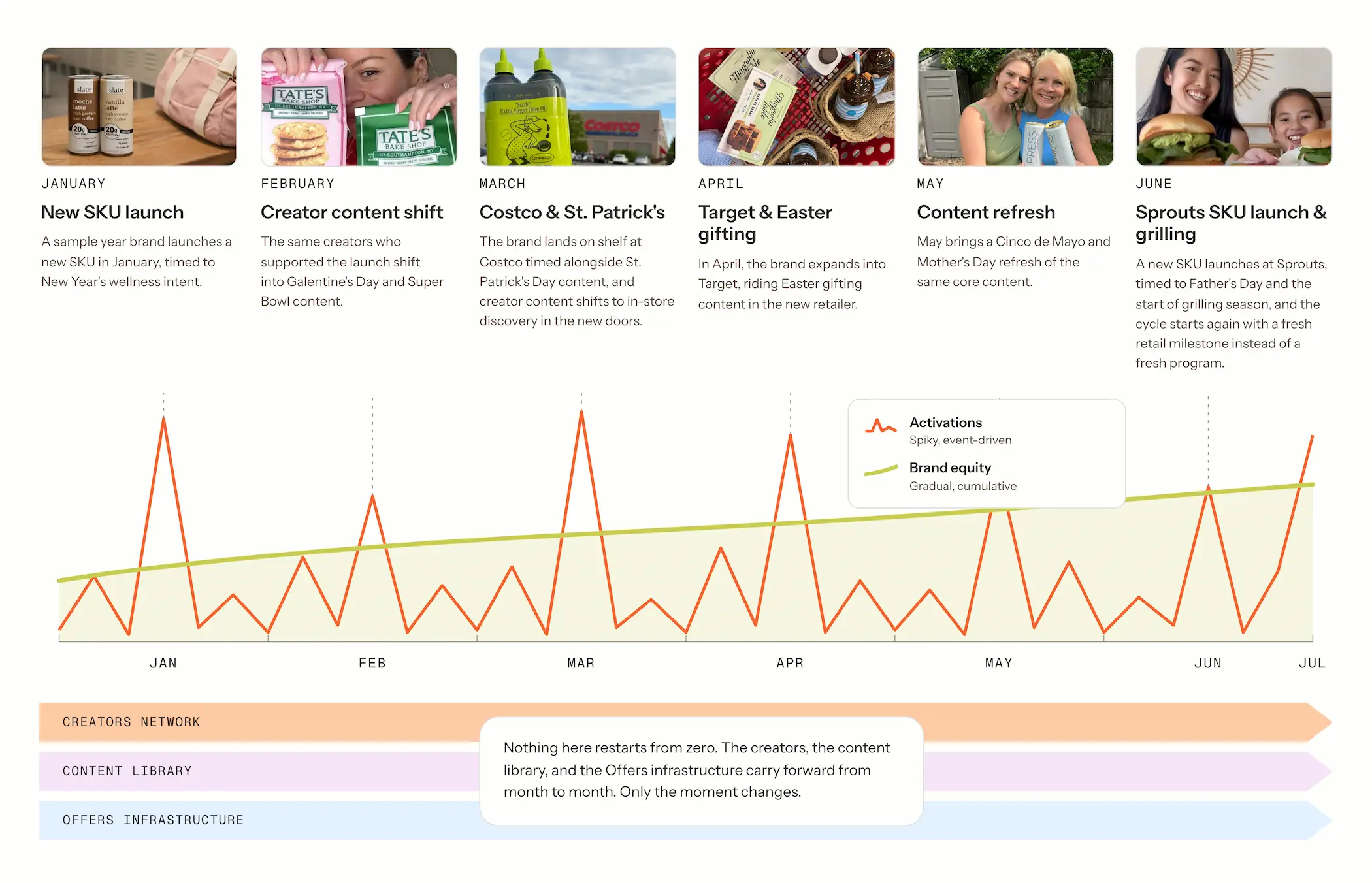
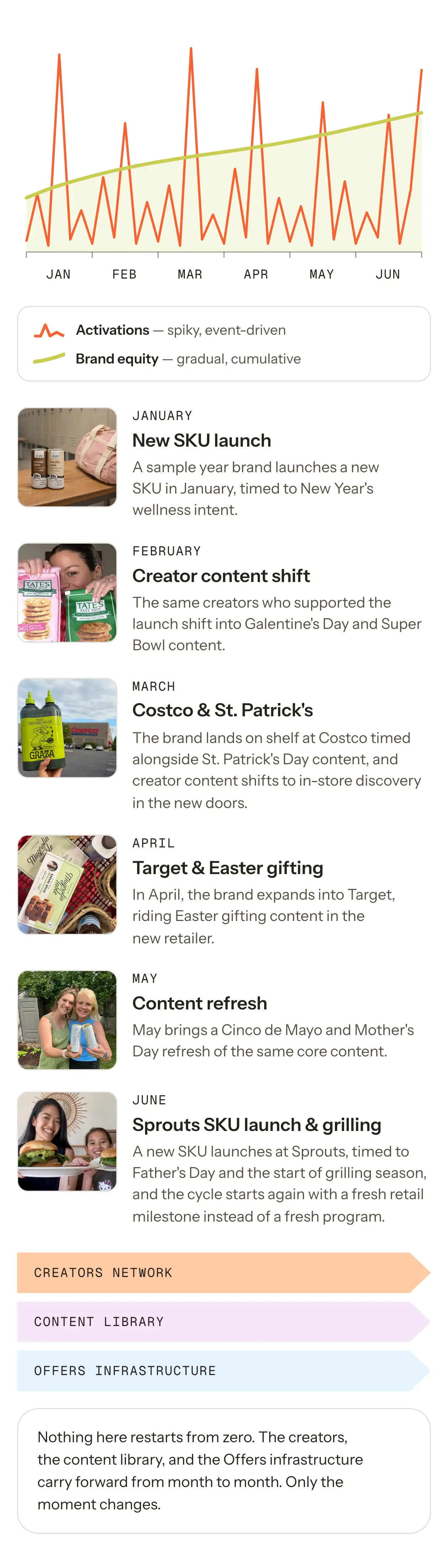
A brand launches a new SKU in January, timed to New Year's wellness intent. In February, the same creators who supported the launch shift into Galentine's Day and Super Bowl content. In March, the brand lands on shelf at Costco timed alongside St. Patrick's Day content, and creator content shifts to in-store discovery in the new doors. In April, the brand expands into Target, riding Easter gifting content in the new retailer. May brings a Cinco de Mayo and Mother's Day refresh of the same core content. In June, a new SKU launches at Sprouts, timed to Father's Day and the start of grilling season, and the cycle starts again with a fresh retail milestone instead of a fresh program.

Nothing here restarts from zero. The creators, the content library, and the Offers infrastructure carry forward from month to month. Only the moment changes.

A rule of thumb on timing:

Work backward from the date content needs to be live, not forward from when planning starts — if a push needs to be live in six weeks, scope and creator sourcing should be locked now, not later. Build in a buffer for retail delays, since an on-shelf date rarely lands exactly when a retailer said it would. And confirm distribution before activating: sending creators to shop where a product isn't yet on shelf burns budget without producing real discovery. Juggling all of this in-house, retail timing, seasonal moments, and creator sourcing at once, is hard and complex to manage without dedicated support.

Product categories tightly tied to specific seasonal moments

Some categories over-index on particular moments far more than others, and it's worth naming that up front so a brand can see where its own category sits on the calendar:

SeasonStrongest categoriesWhy
Q1 (New Year, Valentine's, Super Bowl, St. Patrick's Day)Wellness, supplements, functional beverage, clean beauty, snacks, beerNew Year intent drives health resets; Valentine's and Galentine's drive beauty and food/beverage gifting; Super Bowl and St. Patrick's Day drive snacks and beer
Q2 (Easter, Mother's Day, Cinco de Mayo, Father's Day)Food, candy, beauty, personal care, beverage, spiritsEaster drives candy and food gifting; Mother's Day drives beauty and specialty food; Cinco de Mayo and Father's Day drive beverage, spirits, and the start of grilling season
Q3 (Independence Day, back-to-school, late summer)Food, beverage, household, wellnessGrilling and cookout season peaks around July 4th; routines reset hardest around back-to-school: lunchbox staples, morning beverages, immune and wellness stocking ahead of fall
Q4 (Halloween, holiday, BFCM)Food, beverage, beauty, household, petThe densest quarter across every category: candy and snacks at Halloween, gifting across beauty and specialty food, household stocking for entertaining

The point of this table isn't that a brand outside its "strongest" category should sit out a quarter. It's the opposite: even a brand's off-peak quarter is someone else's peak, which is exactly why a single annual campaign can never cover a full year of opportunity on its own.
03

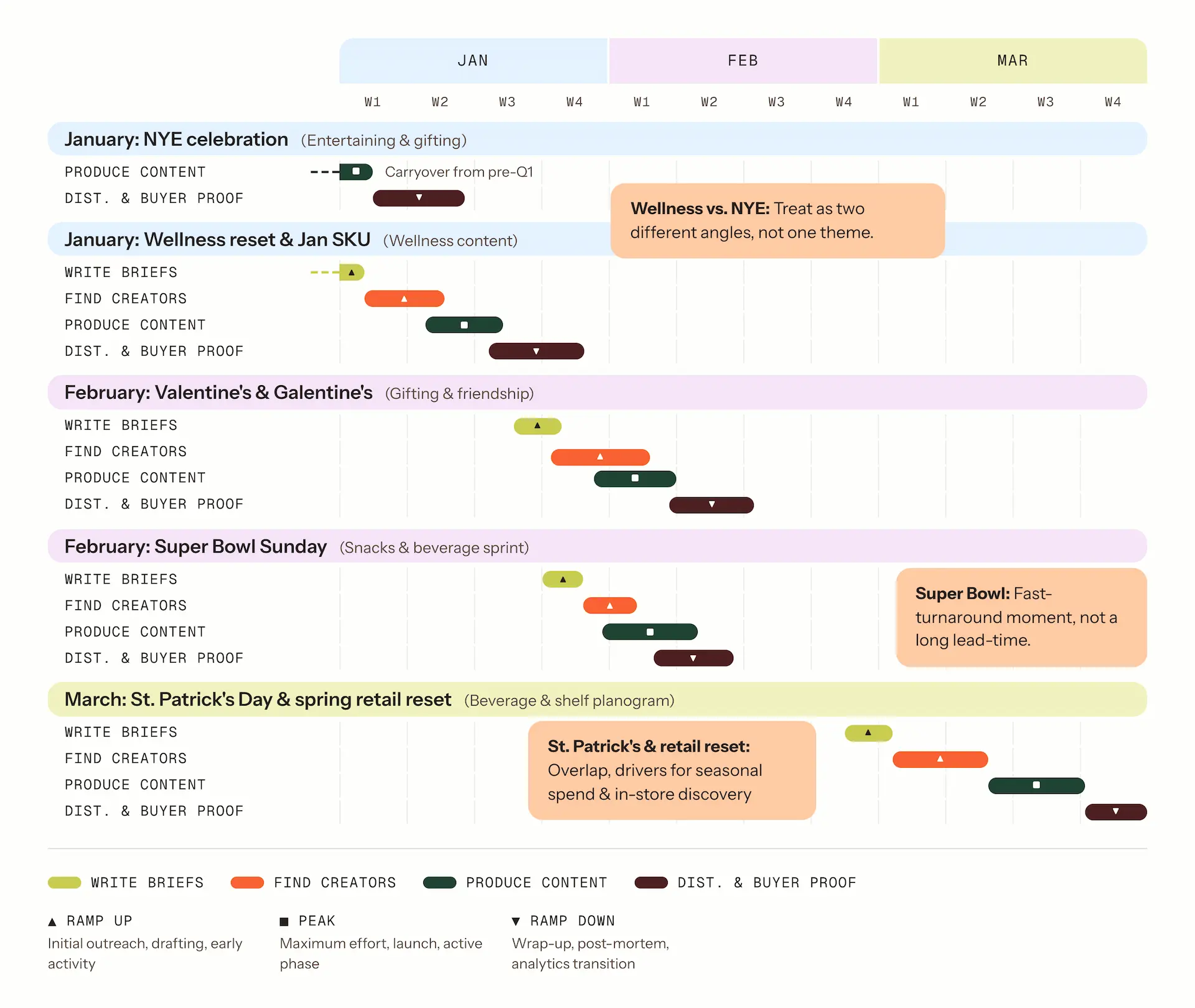
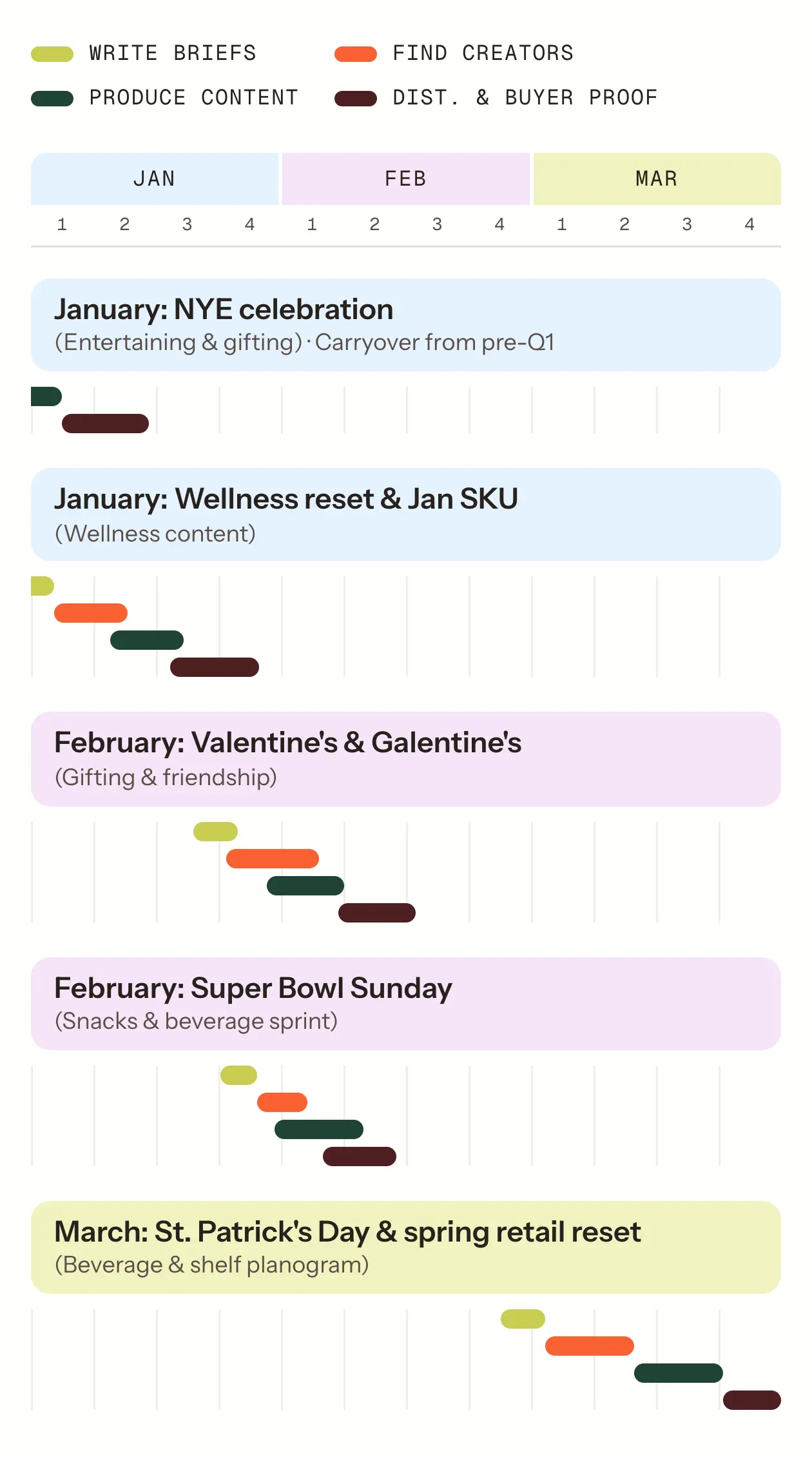
Q1 Ramp-Up & Distribution Timeline: New Year, Valentine's Day, and St. Patrick's Day

January opens the quarter with the wellness reset: hydration, clean beauty swaps, better-for-you food and beverage habits, all riding genuine New Year intent.

February shifts to Valentine's Day and Galentine's Day: gifting content for beauty and specialty food and beverage, plus a self-care and friendship angle that opens the door to categories outside classic Valentine's gifting. Galentine's in particular plays as much into food and beverage as it does gifting: brunches, cocktails, and get-togethers among friends are as much the story here as the gift itself. The first weekend of February also carries Super Bowl Sunday, one of the highest-volume weekends of the year for snacks and beverage, and a fast-turnaround moment rather than a long lead-time one.

March closes the quarter with St. Patrick's Day, a genuine beverage and food moment (beer, Irish-inspired cooking) that's easy to overlook next to the bigger Q1 holidays but drives real seasonal spend in the right categories. Q1 is also frequently when brands land a new retail milestone: a January SKU launch riding New Year intent, or a March shelf reset at a retailer setting its spring planogram, timing that often overlaps directly with St. Patrick's Day content.

Each moment builds on the one before it, compounding into brand equity and distribution efficiency that no single campaign can match.

Mapping out just one quarter like this already looks like a lot to run yourself. Multiply that by four, and it's easy to see why brands hand the whole calendar to Hummingbirds instead. Book a Call to see how we run it end to end.

Athena Club

✨ 2026, But Make It Silky Smooth – Glide Into the New Year with Athena Club 🛁🩵

18
creators
58.3k+
potential reach
630
engagements
12.5k+
reel views
20.1
hours saved
BEEUP

🐝💌 Sweet Lunchbox Swaps For Your Mini Valentine 🍯❤️

10
creators
32.7k+
potential reach
272
engagements
7.5k+
reel views
12.8
hours saved
OLIPOP

🍒💭 Proof That Classics Never Go Out Of Style — OLIPOP Shirley Temple🎀🥤

52
creators
250k+
potential reach
3.1k+
engagements
55.6k+
reel views
64.2
hours saved
EIght elite light beer

🙌 🏆 Stock Up for the Big Game with an Elite Drink—Your game day starts with EIGHT Elite Light Beer🍻

12
creators
65.0k+
potential reach
214
engagements
6.1k+
reel views
9.3
hours saved
04

Q2 Ramp-Up & Distribution Timeline: Easter, Mother's Day, Cinco de Mayo, and Father's Day

April opens the quarter with Easter, one of the biggest food and gifting moments outside the winter holidays: candy, ham and brunch staples, egg-adjacent baking, and a genuine gifting occasion in its own right.

Early May brings Cinco de Mayo, a major beverage and food moment, landing right alongside Mother's Day, one of the highest-intent gifting moments of the year, especially across beauty, personal care, and specialty food. Mother's Day in particular rewards early creator ramp-up more than almost any other Q2 moment.

June closes the quarter with Father's Day, Mother's Day's beverage-and-grilling-forward counterpart, and the unofficial start of grilling and cookout season, a season that doesn't wind down until Labor Day.

Q2 is also a common window for mid-year retail milestones: a regional-to-national distribution expansion, or a new-retailer launch timed to align with a brand's Easter or early-summer push.

Magnolia Table

🐣🥐 Easy Easter Brunch With Magnolia Table Baked Goods From Target

103
creators
761K+
potential reach
5.9k+
engagements
148k+
reel views
87.4
hours saved
Dumpling Daughter

💐🥟 Skip The Stress, Bring On The Dumplings – Dumpling Daughter Makes Mother’s Day Deliciously Simple

9
creators
12.8K+
potential reach
296
engagements
7.3k+
reel views
14.6
hours saved
Papatui

👨👩👦🧴 The Father’s Day Gift Dads, Husbands & Sons Will Actually Love — PAPATUI At Walmart 💙

8
creators
60.1k+
potential reach
464
engagements
5.4k+
reel views
14
hours saved
05

Q3 Ramp-Up & Distribution Timeline: Independence Day, Back-to-School, and National Launch Windows

Q3 opens with Independence Day, one of the highest-volume retail weekends of the year for food, beverage, and household categories, and the peak of the grilling and cookout season that started building back in Q2. That momentum carries straight through to Labor Day, so this isn't a single-day moment to plan around — it's a season.

Back-to-school is the anchor moment of Q3 and the strongest proof point Hummingbirds has for what always-on creator support looks like at scale. See the full OLLY back-to-school case study for how retailer-specific creator activation performed across Walmart, Target, and Costco within a single coordinated window. That same structure — three retailers, one coordinated window — is the model for any brand entering Q3 with a national launch to support.

Late August into September also carries the late-summer transition: routines resetting around fall, immune and wellness stocking ahead of cold season, and the shift out of travel-and-convenience content into at-home routines.

Q3 is frequently when a brand's biggest annual retail milestone lands: a national launch, a major new-door count, or the retail moment sales has been building toward all year. This is where UGC has to do double duty — proving demand to consumers and proving momentum to the retail buyer in the same piece of content.

Garrett Popcorn

🎈🥳 Found the Party in the Snack Aisle — It’s Garrett Popcorn’s Birthday Cake Popcorn! 🍿🎂

12
creators
75.7k+
potential reach
305
engagements
7.2k+
reel views
19.1
hours saved
OLLY

🎒💛 Class Is Back… So Is My OLLY Target Run

48
creators
236k+
potential reach
1.7k+
engagements
38.8k+
reel views
56
hours saved
MOSH

☀️➡️🎒 Summer’s Out, Protein’s In — Get Back To Routine With MOSH 💪

22
creators
120k+
potential reach
1.6k+
engagements
70.6k+
reel views
37.5
hours saved
06

Q4 Ramp-Up & Distribution Timeline: Halloween, Thanksgiving, Holiday Gifting, and BFCM

Q4 is the densest quarter of the year and the one where always-on infrastructure matters most, because there is no time inside the quarter itself to build a program from scratch — scope and creator sourcing for an October-through-December push typically needs to lock in August or early September to hit shelf dates without a scramble. Halloween opens the quarter with candy, snacks, and costume-adjacent beauty content. Thanksgiving and Friendsgiving follow with hosting and pantry-stocking content. Black Friday and Cyber Monday compress a brand's biggest sales moment of the year into 96 hours. Holiday gifting runs through December across nearly every category. New Year's Eve closes the quarter as its own celebration and gifting moment, distinct from the January wellness reset that opens Q1, and hands the calendar back to the top of this guide.

This is also the quarter where the case for retail support is highest-stakes. A brand that has spent all year building velocity can lose it in a single soft month: as one Hummingbirds brand partner put it, an underspent month at the wrong time can mean wasting the shelf space a brand fought all year to earn. Q4 is where that risk is highest, and where continuous creator and Offers activity does the most to defend it.

The way to run Q4 without overloading the team is build → splash → sustain. Build creator relationships and content ahead of the quarter, splash hard around two or three priority moments (a launch, Black Friday, a retailer's biggest week), then sustain lighter activity in between so the shelf never goes quiet. Onboarding, approvals, creator selection, and posting windows all add up faster than expected once October hits, which is exactly why leaning on a partner who's already running that process beats building it from scratch under a deadline.

The Honest Kitchen

🐾👻 Tricks Are Fun, but Treats Are Better! Honest Kitchen Has Your Pup Covered This Spooky SZN 🎃🧡

10
creators
25.6k+
potential reach
474
engagements
755
reel views
6.3
hours saved
Hero Bread

🍞From Sliders to Stuffing — Serve Holiday Classics with Hero Bread✨

9
creators
86.9k+
potential reach
2.5k+
engagements
28.8k+
reel views
12.5
hours saved
Simple Mills

Snack to Impress: Build Your Best Holiday Boards with Simple Mills 🧀🍇

15
creators
79.9k+
potential reach
810
engagements
13.0k+
reel views
28.8
hours saved
07

How Hummingbirds Facilitates It: The Credit System

An always-on program doesn't mean a bigger commitment. It means a smarter one. Annual plans on Hummingbirds run on a pool of credits allocated across the seasonal themes and retail milestones a brand actually cares about, not a fixed one-size-fits-all package built around a single campaign. Priorities shift and launch dates move, so credits can be reallocated between quarters, retailers, or products as that happens, without renegotiating the plan.

One flat rate applies per Offer, regardless of cash-back value, so a bigger moment doesn't cost more to run. Offers can be set at the exact store level, so a brand only ever activates where product is actually on shelf, never wasting reach on doors it hasn't landed in yet. There's no separate coupon vendor and no bolted-on attribution tool to manage alongside it. It's one system, priced for a growth-stage team proving ROI on a lean budget, not an enterprise retail-media minimum.

Example: a 200-credit annual plan for a F&B brand at Target

AllocationCredits% of plan
Always-on baseline (year-round UGC, community content)4020%
Q1: New Year, Valentine's Day + St. Patrick's Day3015%
Q2: Easter, Mother's Day + Father's Day3015%
Q3: Independence Day + back-to-school3015%
Q4: Halloween, holiday, BFCM7035%
Total200100%

Why the model holds up at scale:

  • 70,000+ creators are active on the platform and growing, so sourcing enough creators for any single moment isn't the constraint
  • No campaign is guaranteed a set number of applicants, but brands can generally expect somewhere in the range of 200-400 applicants for every 20-30 spots, which is what keeps content quality and creator fit high even on a fast timeline
  • Hummingbirds handles the majority of the briefing work on every campaign, so an always-on cadence doesn't multiply a brand's own workload alongside it

Success is measured the same way from the first campaign to the two-hundredth: content volume and quality, plus verified redemptions and purchases tied to specific SKUs and retailers, all in the same dashboard where the creator content lives. That's what turns a brand's proof of what already works into a reason to keep investing in it. Scaling the program isn't a leap of faith. It's a decision backed by the brand's own data.

08

Distribution: How Content Keeps Working

Content built for one seasonal moment doesn't retire when that moment ends. A back-to-school testimonial doesn't stop being useful once September passes. It can resurface in a wellness-focused email months later, or anchor a paid ad during a completely different quarter. The work is already done. The only question is where it shows up next.

Offers work the same way. Once a piece of content proves a product moves at a specific retailer, that same Offer can keep running in the background, quietly converting the awareness that content built into verified purchases, long after the original post stops getting attention.

Here's where that content and those Offers keep earning their keep:

Paid ads

Roughly 20-30% of the content built for any single moment is ad-ready as delivered, so a strong organic post can move straight into paid social as ad creative, no separate production cycle required.

Organic social & Stories

The same content keeps circulating past its original post — pulled into a highlights reel, reformatted for Stories, or resurfaced across a brand's own channels wherever it fits.

Email

Verified customer voice from one seasonal push becomes social proof in an email campaign built around a different moment entirely — a back-to-school testimonial, for example, resurfacing in a "trusted by real customers" section of a wellness-focused send.

Retailer & landing pages

A retailer-specific piece of content doubles as a landing page tile or reference asset anywhere that retailer relationship shows up next.

09

Your Always-On Roadmap

A brand doesn't need Hummingbirds to start thinking this way. The goal isn't to predict every campaign a year out. Lock in the tentpole moments a brand already knows it'll support every year, back-to-school, the holidays, a major retailer reset, and build the plan around those first. Then leave real room for what can't be predicted yet: a packaging refresh, a new SKU, a shelf placement change, a retailer opportunity that comes up mid-year. The annual plan should give a known foundation with enough flexibility to react as the business changes.

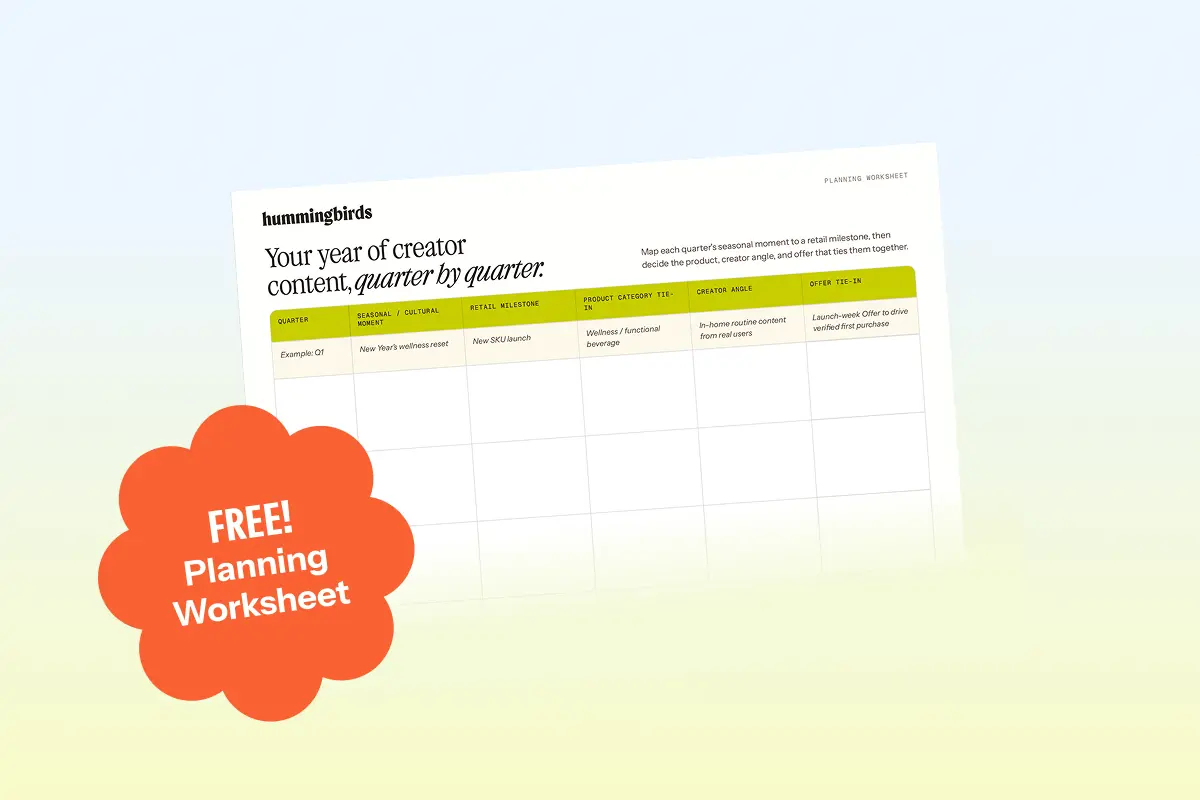
Grab our UGC planning worksheet to map the year ahead before deciding how much of it to run alone versus hand off.
Ready to build your always-on year?