
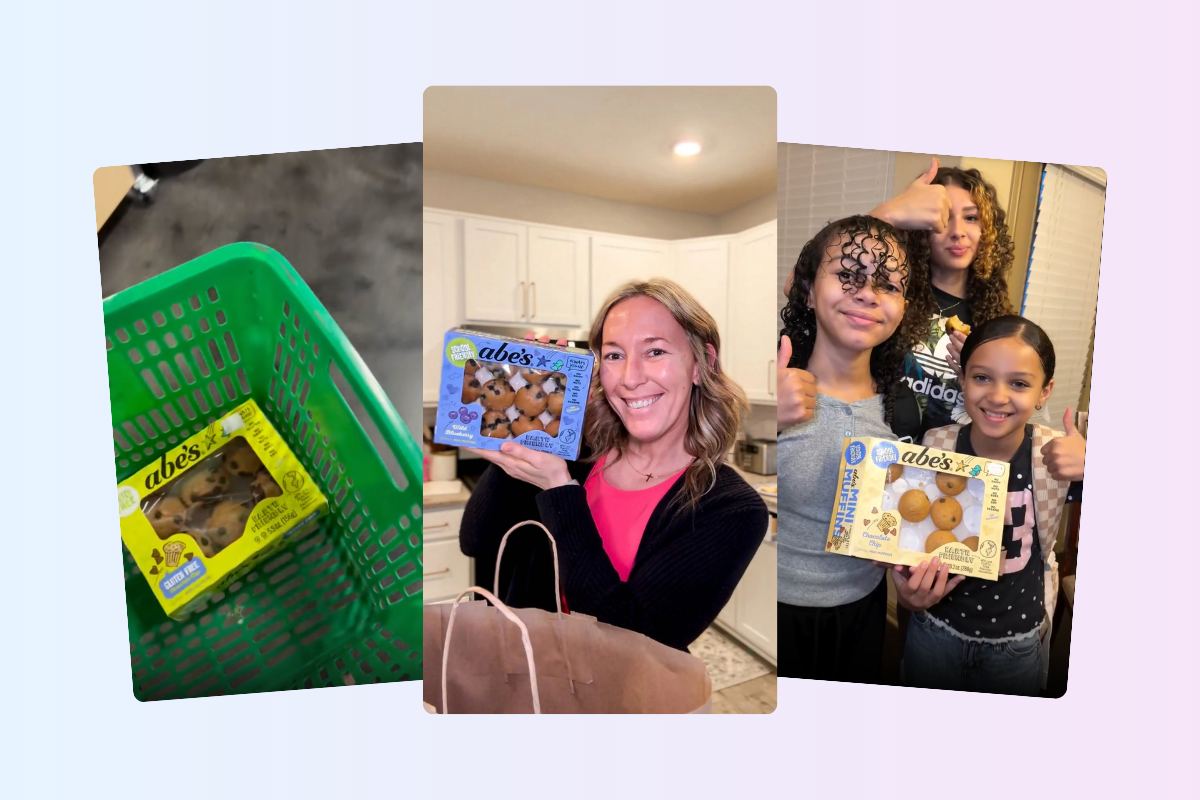
Parents already trusted Abe's Muffins. Retail creators helped amplify that word of mouth in every market where it sells.
How Abe's Muffins used Hummingbirds retail creators to amplify the trust it has earned among parents at Sprouts and Target, then took that content further with whitelisting.
Three takeaways for CPG marketing leaders
In a category where parents rely on each other for what is safe to pack, Abe's selected everyday creators who already shop the aisle and live the problem the product solves.
Retailer-specific campaigns at Sprouts, Super Target, and beyond gave Abe's shelf footage from markets its New York team can't reach, plus proof it could share with retail partners.
Organic gave Abe's authentic content that worked on its own. Running it as partner ads from each creator's handle took it further, lowering CPE to $0.024 (108x lower than organic) and CPM to $8.73 (versus $152.63 organic).
A high-touch brand in an aisle shoppers hesitate to try

The Abe's brand was founded in 2016 for the real Abe, who, like an average of two children in every classroom, was often left out due to his food allergies. All Abe's muffins and mini cupcakes are free from dairy, eggs, nuts, soy, sesame, and pea protein, and are produced in a dedicated facility that parents of children with food allergies trust wholeheartedly.
That makes Abe's a very high-touch brand, in Head of Marketing Tiffany Syrop's words. Parents managing food allergies lean on each other for what to pack and what to trust, and free-from products can feel like a no-touch zone until someone actually tries them. Abe's in-store demos convert well once shoppers taste the product, but demos can't be everywhere.
Finding those voices was also slow. Before Hummingbirds, Marketing Manager Caitlyn McKearney sourced creators one by one through Instagram search and direct messages, negotiated every deliverable, and packed and shipped product herself, which she called labor intensive, time intensive, and super costly.
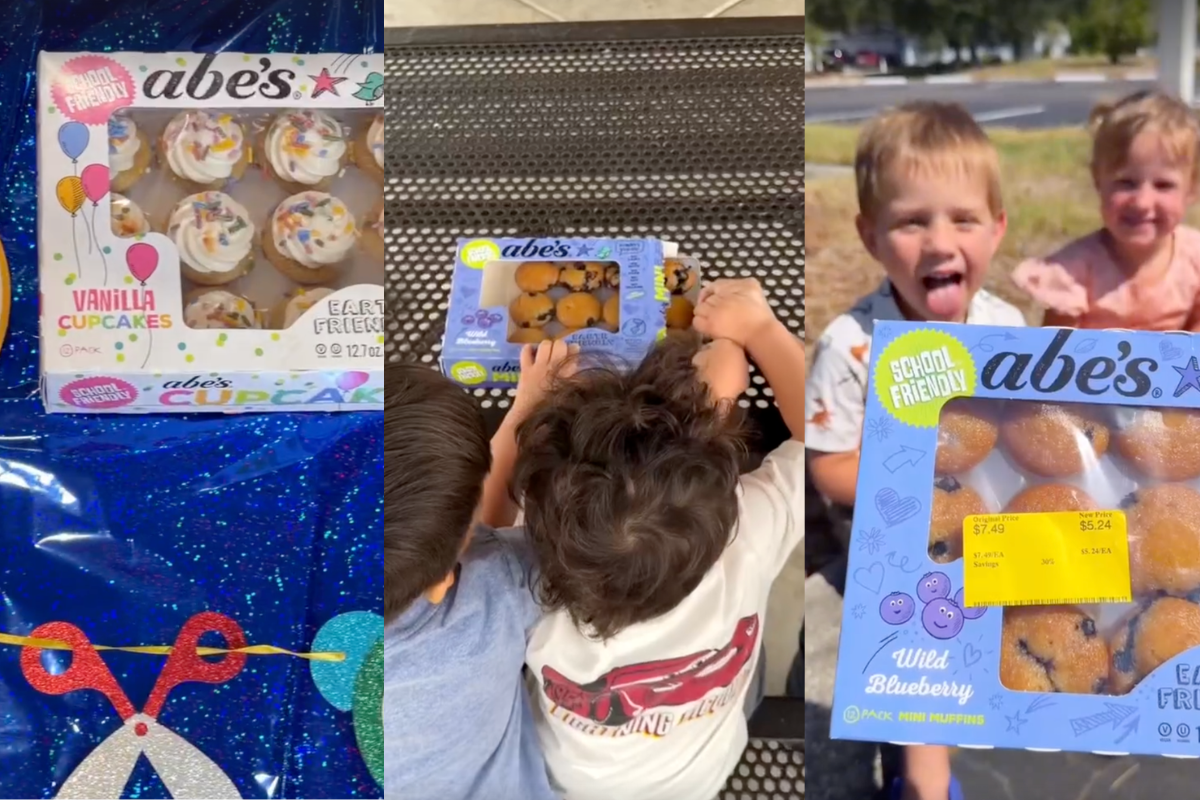
Retail creators in every market Abe's sells
On Hummingbirds, Abe's found a community of 80,000+ everyday creators. They are retail creators, real shoppers already packing lunches and planning classroom parties, with a hands-on team behind every brief and campaigns that move from brief to finished content in about four to five weeks. Abe's built its program around the retail moments that matter most, so every post helps shoppers discover the brand where they buy.
Exclusives, in Sprouts markets only
For limited-edition cupcakes sold only at Sprouts, Abe's activated everyday creators in 36 Sprouts markets, so every post pointed to a store where the product was on shelf.
A new door, launched across 24 markets
When Abe's arrived at Super Target, retail creators showed shoppers where to find it, delivering the in-store footage Abe's needs whenever it lands a new retailer.
A field team Abe's doesn't have to staff
Creators capture the storefront, the aisle, and the shelf in markets from Houston to Las Vegas, footage a New York-based team couldn't get on its own.
For its biggest moment of the year, Abe's opened the brief
Back-to-school is Abe's most important season, since the brand exists to make classroom snacks safe for kids with allergies. In 2026, Abe's ran two campaigns built for different jobs. Pack a Safer Snack was a Sprouts-exclusive push across 36 markets. Lunchboxes to Classroom Parties removed the retailer and product restrictions entirely, letting everyday creators in 14 markets choose any flavor at any store.
Pack a Safer Snack won on rates, with the highest community engagement rate of any Abe's back-to-school campaign. Lunchboxes to Classroom Parties won on volume, with the most Reel views of any Abe's campaign in 2026. Setting the goal up front shaped the creator roster, and the roster shaped the results.
Every campaign beat the industry benchmark
Across all seven Abe's campaigns on Hummingbirds, every one posted an engagement rate by reach above the 7% industry benchmark.
The pattern underneath matters just as much. Across all seven campaigns, rosters of smaller, more niche everyday creators consistently earned higher engagement from their own communities, regardless of theme. As AI-generated content spreads, that kind of real, first-person recommendation is getting harder to fake and more valuable to earn.
Whitelisting took strong organic content even further
Abe's has long used its Hummingbirds content as Meta ad creative, and the organic posts are strong on their own. In September 2026, it tested how much further whitelisting could take that content. Posts from the Lunchboxes to Classroom Parties campaign ran across the same 14 markets for one week, both organically on creators' own feeds and as partner ads from each creator's own handle on an Engagement objective.
What it means for CPG brands
- Organic creates the asset, and it stands strong on its own. Every whitelisted ad ran on content everyday creators first made for their own communities, which is where its authenticity comes from.
- Whitelisting scales the voice, not just the reach. Because the ad comes from a real person's handle, shoppers engage with it the way they engage with a friend's recommendation.
- Pair the format with the right goal. Whitelisted creator ads performed best on an Engagement objective, earning each engagement for about $0.024, because that first-person trust does the most work there.
- The math holds at program scale. Layering whitelisting on top of an 18-creator organic program would take cost per engagement from $2.61 to $0.06, about 45x lower, while roughly doubling total spend.
Creators who stay with the brand
The impact doesn't stop when a campaign closes. Everyday creators come back for future Abe's campaigns or tag the brand on their own while packing their kids' lunches, and Abe's plans to keep Hummingbirds as a core source of social and paid content heading into 2027.

More from our conversation with Abe's
How does Abe's choose which creators to select?
Abe's uses the content pool in the Hummingbirds dashboard to review each creator's past campaigns in one place, since a creator's everyday feed can look very different from the content they make for brands. Reach and engagement data also support Abe's reporting, because creator posts don't appear on the brand's own profile.
How does Abe's use retail creator content beyond the campaign?
The content becomes Meta ad creative, organic social posts, and in-store footage for new retail launches. A Mother's Day post built entirely from creator clips across separate campaigns performed especially well on the Abe's feed.
Why did Abe's whitelist its creator content?
Whitelisted ads run from the creator's own handle, so shoppers engage with them the way they engage with a recommendation from a real person. Organic posts already carry that authentic voice, and whitelisting takes it further. In Abe's test, whitelisted ads delivered a CPE 108x lower than organic posting while keeping the content's authentic, first-person feel.