
How Force of Nature Translates Regenerative Ag Into a Story That Sells at Shelf
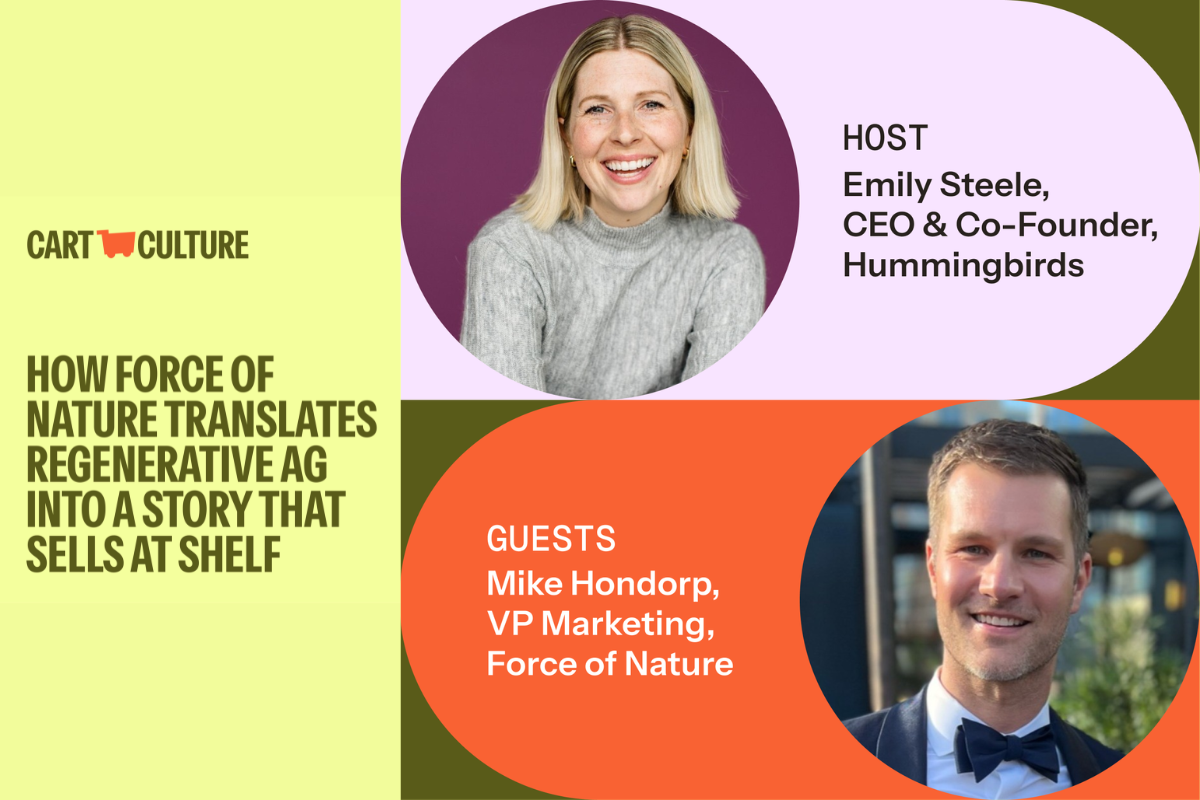
Regenerative Agriculture Is Hard to Pronounce. Here's How Force of Nature Sells It Anyway.
Force of Nature's VP of Marketing, Mike Hondorp, joins Hummingbirds' Cart Culture to unpack how a mission-driven meat brand translates regenerative agriculture into shelf-level trust, an omnichannel consumer journey, and real retail velocity, without losing shoppers in soil-health jargon along the way.
Regenerative Ag Only Sells If It Speaks Consumer, Not Science
- Force of Nature leads with “meat you can trust” and “it's just better”, not soil health or protocol detail. The deeper education comes later, once a shopper is already engaged.
- Two campaign misses, “I Am a Force” and an earlier push built around soil health, taught the team that concept and performance have to connect, or the story never gets past the hook.
- The brand matches message depth to attention span: 5 seconds at shelf earns a claim and a picture; 1 to 3 minutes on-site or in an email is where the deeper story gets told.
Trust Is Manufactured Through Proof, Not Just Positioning
- Independent testing across 300+ agricultural chemicals, heavy metals, and PFAS backs every “meat you can trust” claim with data, not just brand language.
- Nutrient testing shows Force of Nature beating USDA, conventional, and even organic benchmarks, the kind of specific comparison that gives a claim teeth with both shoppers and retail buyers.
- Proof only works with context: an early product-page test showed that nutrition data alone, without an explanation of what the numbers meant, actually underperformed.
First-Party Relationships Beat Third-Party Data
- Most retailers won't share consumer data without a brand paying heavily for it, so Force of Nature built its own channel: a single email survey pulled 1,000 responses in the first six minutes.
- Ecommerce customers, not retail POS data, are Force of Nature's richest source of insight into which claims and messaging actually move people.
- Small, quiet “surprise and delight” gestures, like fixing a bad delivery or replying to a social comment personally, do more for loyalty than automation ever could.
Being a Brand in a Commodity Category Rewrites the Retail Playbook
- Meat is one of the least-branded aisles in the store; Force of Nature is competing in a category run by a handful of large players where most competitors invest little in marketing or storytelling.
- That investment shows up at the buyer level: natural retailers respond to the story strongly enough that buyers actively campaign for more shelf space, while mass retailers still negotiate primarily on price.
- The answer to a price conversation isn't a discount. It's proof that storytelling and marketing spend convert into measurable in-store performance.
Welcome to Cart Culture: Mike Hondorp & the Force of Nature Origin Story
2:37Emily Steele: Cart Culture is all about revealing the real forces behind what ends up in the cart. We're here to have live conversations that unpack how culture, community, and creativity shape modern buying behavior. We've talked to Kate at NIQ, social media teams, and brand operators from Everyday Dose. I run Hummingbirds, which started in my own backyard in Des Moines, Iowa, bringing together everyday creators who work with CPG brands and retail to tell their story, create visibility, and drive velocity through our latest product offers.
I'm obsessed with the moment discovery turns into cart action, the human psychology behind why creators can be so successful for brands. We've been helping CPG brands drive real-world discovery and retail momentum through our creators for the last four years, working with hundreds of customers. Today we're diving into something I think is incredible: Force of Nature's value prop, and how translating that into a pack of meat on shelf is a real challenge to overcome. We'll get into mission-driven subscribers versus price-comparing shoppers, and how Mike's background building Instagram and Cameo has shaped what's going on at Force of Nature.
5:01Emily: Mike, do you want to tell us a little bit about you, your background, and what Force of Nature is for anyone new here?
Mike Hondorp: Thrilled to be here. I run marketing at Force of Nature Meats, one of the first scaled regenerative meat companies out there. What we're committed to doing is bringing better meat to more people, and by doing that, building a more regenerative but also scalable food system. Our food system is pretty broken, and we want to be an active player in healing it and making it better.
5:44Mike: My path here was pretty unlikely. I spent most of my career largely in retail marketing or technology on the platform side: Instagram, Cameo, and way back in the day, early Bonobos, the men's pants company that had the audacious idea of selling pants online in the early 2000s. In a post-COVID era, I knew I needed two things: a company with a mission that mattered to me and to millions of people, and one that was quote-unquote real or measurable. The second piece was wanting to work with good people, people I respect, who treat people kindly. That starts at the top.
A friend of mine asked, “Would you ever work at a meat company?” and I thought it was one of the strangest questions I'd been asked in my career. Fast forward, and I can't think of anything else I'd rather be doing, because I believe in the mission.
7:08Mike: Force of Nature ultimately cares about three things. Are we producing something that's better for you? Are we producing something that's better for the animals? Are we doing something that's better for the planet? If we're doing all three of those every day, that's what gets me excited, and that's ultimately how I ended up here.
Nutrition you can measure
Products tested to deliver more nutrition than USDA, conventional, and organic benchmarks.
A life on pasture
Animals live, eat, and roam the way nature intended, with no feedlots and no confinement.
Regeneration, not just sustainability
Every ranch in the network is measured on how it heals the land, not just maintains it.
From Epic Provisions to Retail
7:51Emily: What's the origin story on direct-to-consumer to retail, and what's that journey looked like?
Mike: Our three co-founders worked together at a company called Epic Provisions. The Epic Bar is still on shelves today, and it was one of the first meat-based protein bars out there. It was a wild idea that worked, and the company was eventually acquired. Throughout that process, our founders kept asking: how do we translate this mission from ounces to pounds? We could scale our impact infinitely if we did this at a bigger scale. So they set out to create a better meat company, with regenerative being core to what we do, but not all that we do. Force of Nature was founded to raise the standard altogether for the meat industry, not just to have high standards ourselves.
9:03Mike: We were founded in late 2019, and we all remember what happened in early 2020. We were just getting off the ground selling to Whole Foods and Central Market in Austin, where we're based, and then the world shut down. We had a massive amount of inventory that was about to go to restaurants and retailers who were shutting their doors, so we quickly pivoted to a D2C and ecommerce business. Retail came back pretty quickly and became a lifeline, but ecommerce was how we got our inventory into people's hands while they were excited about cooking at home.
Today we have a thriving ecommerce business, but it's a fraction of the revenue of the company. The vast majority of what we do is retail, and it always will be, because that's where people buy fresh and perishable food. We also do food service, but retail is the name of the game.
Translating Regenerative Ag Into “Meat You Can Trust”
10:19Emily: Knowing retail has such a profound impact on the company, how do you think about getting the mission all the way to the shelf, to a buyer who may have never heard of regenerative agriculture?
Mike: It all starts with the consumer. We have a really exciting mission and a huge, chunky backstory. We're a triple-bottom-line company, and regenerative agriculture is both exciting and hard to understand, and hard to pronounce. So when I say customer-first, I mean we think first about what people want and need. Our consumers have told us, quite simply, that they're looking for better-for-you products. That's amazing, because it's something we can prove: we test to ensure we're delivering more nutrition than USDA benchmarks, than conventional benchmarks, than even organic benchmarks. But consumers are also looking for something to believe in, and that's where our story gets exciting.
12:14Mike: Our mission isn't solely regenerative. It's to make a better food system, but we believe regenerative practices are what gets us there. We think of regenerative as working with nature instead of against it. If you think about the life of a cow or a ruminant animal that can convert the complexity of grass into nutritious meat, that animal lives on the land it was meant to live on, eats the food it was meant to eat, and does the work of making that land healthier through the way it lives. It moves on, and as a result, that land recovers and regenerates.
Mike: An industrialized system, by contrast, is inherently extractive: mechanical inputs, chemical interventions to avoid weeds and pests that degrade land quality, less welfare for animals, and a lower nutrient profile in the final product. It's a lot to unpack: soil health, land health, water health, mineral cycling. But ultimately it's a better product, and what we say to consumers, because they've told us they care about something better for them that they can believe in, is meat you can trust.
Mike: That phrase means a lot to a lot of people, and we can back it up through our protocols and testing. If we say “meat you can trust” or “it's just better,” which was a big campaign last fall, consumers react positively. Then they start their journey: they go to our site, they Google, or they work with AI to understand regenerative agriculture. It's exciting to tip off that conversation and bring them into something they can believe in.
The Omnichannel Journey: Shelf to Subscription, Regenerative vs. Organic
15:07Emily: This is a commodity category that you've put a brand to, and that's different from the typical meat-aisle experience. Do people align with the messaging and buy, or are they curious and in discovery mode first? Or is it both?
Mike: It's both. Our most valuable consumer at Force of Nature is an omnichannel consumer. Often, the first point of entry is seeing a brick of our frozen or fresh ground meat on the shelf at Whole Foods, H-E-B in Texas, Publix in Florida, or another market. That brick does an amazing job of painting the picture of what we do. We were one of the first brands to actually put the animal on the pack, with claims that resonate: grass-fed, pasture-raised, or regeneratively raised, depending on the protein.
If that product tastes good, which we hope it always does, we often find great product-market fit, and consumers discover we have an ecommerce site. If they're going through a certain amount of product a week, it can be more economical to subscribe on ecom and have it shipped frozen right to their door, saving money and making fewer trips to the store.
18:04Mike: There are consumers whose first interaction with us is online, but our online business is interesting: we're selling highly perishable products with a fairly high minimum order value to qualify for free shipping, because it's a lot to ask on something a consumer has never tried. So regardless of your touchpoint, we try to invite you into a story, whether that's on the back of pack at retail, on POS or shopper marketing, or in-store signage, and that same message and story translates in ecommerce. Every consumer gets something tactile from us: stickers for kids, a postcard written by a founder about our “soil builder of the month,” which could be a bison or an owl, so you can feel that connection from day one and go on the journey with us.
Regenerative vs. Organic: Myth-Busting for Shoppers
19:03Audience question: How do you get people to change their shopping habits, to buy regenerative instead of organic? What's caught shoppers' interest to go your direction instead of their current ways?
Mike: This is really relevant for an ecommerce shopper willing to do the research on our website. If we're trying to change shopping behavior, we have to prove that we're better, which we say, but we can also prove. We never want to demonize other players in the industry. I'm incredibly thankful for the organic movement, which is well ahead of where regenerative is hoping to be. But we do try to do some myth-busting: most organic beef comes from dairy cows fed in confinement, but raised on organic feed. Is that the system you want to be part of for meat, or would you rather be part of a regenerative system where animals never step foot in confinement, never deal with antibiotics or GMOs, never see a feedlot, and always live on grass with zero supplementation?
21:04Mike: That might be okay for spinach, but for beef, we think maybe not. We're earlier in that phase with chicken. Most of that industry is relatively horrific, and we don't want to show consumers the horrors of industrialized chicken; we want to show them the beauty of what we do. The vision you have of an animal on pasture, free to roam and exhibit natural behaviors, is the reality of our program. If we can show you that, we don't have to show you the alternative.
Emily: The six-minute video on your website does a nice job of showing what's typical without over-indexing on it. Seeing the bison running free on the land, it's similar to being in Yellowstone. The visuals of regenerative agriculture are so compelling once you see them.
Marketing Universal Truths: Instagram, Cameo & Patagonia
23:07Emily: For the early-stage founders on this call, is there anything Force of Nature has learned on the marketing side that applies no matter what you're selling?
Mike: I do think there are universal truths, and it always comes back to: what do people want, what are they ready for, and what can we uniquely provide? When I started at Force of Nature, I did a deep dive into what we were saying: beautiful visuals, gorgeous packaging, but a lot of messaging that was probably going straight over people's heads. We were talking about soil health, which is probably the most important thing in regenerative agriculture, but is that what's on a shopper's mind at H-E-B, or is it price comparisons and claims on the pack, just trying to get something so she can get the kids to school? Probably the latter, before soil health. So we lean into universal truths around “meat you can trust,” backed by data.
25:10Mike: This connects to my time at Instagram, where the currency we were seeking was time and attention. Instagram launched as a visual inspiration platform, literally a photo-editing app, and became something else because consumers told us that's what they wanted, not by saying it, but by doing it. The same is true here: consumers are telling us what they care about, and it's nutrient density and specific claims. We tell them how we're different there, while also telling our own story, hoping they come along on the journey. We always defer to the consumer over what we want to say, because if we lead with what we want to say, we're going to miss the mark, since we're not listening.
28:24Mike: The exciting thing about a mission-based CPG company is that we're leaning on the consumer the same way, but the currency is different. It's not time and attention, it's purchase, so we can solve for the mission of improving our food system. That's about differentiation, positioning, standards, and integrity, creating a real bond with consumers, not just something that gets them to spend more time with us. The brands that do this really well, like Patagonia and Yeti, are so much more than a jacket or a cooler. It's a lifestyle, a set of beliefs, something to be inspired by. If we can do even a fraction of that, I'd be really proud.
Channel Strategy & Proof Points: From the 5-Second Shelf to 917 Ranches
Emily: As you think about the channels that have made a big impact, beyond the product and package drawing people in, what's resonated most for the mission-driven, conscientious buyer?
Mike: It comes down to those 5 seconds we have with a consumer at shelf, versus the 1 to 3 minutes we hopefully get on our site. It's a really striated channel strategy. One of our most performant channels for our ecommerce and omnichannel consumers is our email and SMS lifecycle program. That's where we can go deep with the consumers who've told us they're receptive to it, while others get a two-sentence email and the deal they've been looking for. Our protocols run dozens of pages per protein, but we're not going to lead with that, because we'd miss everybody. We'll show it to you when you're ready for it.
32:44Mike: One thing we think about a lot: we haven't published every test we've done, but we have a large amount of data with our third-party partner Audacious and other testing partners, covering antibiotic-free status and 300-plus agricultural and other chemicals, along with heavy metals and PFAS. That's how we prove what we do, but we still have to translate it into human language. We ran an early test on one product's page, comparing a version with our full test results against one with just the standard nutrition facts panel. The version with just the nutrition panel failed, because we hadn't set the context that our omega-6-to-3 ratio is dramatically above conventional norms, the one number that actually tells you whether meat is truly grass-fed.
Mike: The validation piece is key. We can talk all day about what we stand for, but without proof, it means nothing. We're not organic certified or ROC certified; short answer, it costs our consumers more, it costs our ranchers more, and it costs us more, without actually creating a better product by our standards, but we still have to set that context.
35:55Mike: Being a lean team, we don't have a ton of retailer-provided consumer data unless we pay heavily for it, so we rely on SPINS data to tell us where trends are working in the natural channel, which is the bulk of our business. But the real gold mine is our ecommerce consumer, incredibly receptive to surveys and one-off conversations. When we send out a survey, 1,000 people will respond in the first six minutes. That's wildly useful for creating messaging around products. We have so much more to go on this data piece, including brand awareness tracking that goes beyond a number like “80% brand awareness” into something far more insightful.
Mike: Being a brand in a commodity category is a unique thing. There aren't many brands of meat; most people buy off a white styrofoam tray from behind the butcher case. When I was interviewing, our CEO Robbie asked me what my favorite brand of meat was, and I realized it was a trick question, and that's exactly why we're different. We're building a brand in a space run by four companies that's entirely commoditized, and most of our competitive set doesn't invest in marketing or storytelling the way we do.
Mike: We're not vertically integrated, by design. We don't own land, animals, or processing plants. We work with 917 ranches and ranchers who abide by our protocols, going through a rigorous onboarding process and an annual evaluation we call our Land Steward Index. We ask our producers every year not just about their animals and land, but about their ecosystems, including what species they're seeing that they haven't seen before as a result of these practices. Regenerative isn't an output, it's a system, something so much bigger than the product. The global supply of cattle, beef, and bison is at all-time lows, so our team works day in and day out to bring new producers into these protocols.
Want Your Brand's Story to Sell at Shelf Like This? Let's Talk.
What Hasn't Worked, Superfans & What's Next
44:17Emily: Force of Nature is clearly landing with consumers, but you've surely tried things that haven't worked. Any examples?
Mike: What doesn't land is when we get really deep, really fast. Soil health is probably the single most important thing in regenerative agriculture, but talking about it at retail with no other context just reads as, “wait, aren't you trying to sell me beef?” Zooming out has been a big strategy for us. It doesn't mean we're dumbing anything down, it means meeting the consumer where they are. The campaign that worked after that pivot was “it's just better”, slightly provocative, and it earned the follow-up: “okay, let us show you.”
Mike: The continuous tension is finding the balance between aspiration, inspiration, and brand concept versus performance, meaning what actually gets the sale, the feet in the door, the click to purchase. We found that concept has to start simple, then bring people on a cooler journey over time. Earlier this year we ran a campaign called “I Am a Force” across TV, out-of-home, social, and paid digital, a big idea tied to our brand name, but I'm not sure we connected the dots well enough for consumers to understand why they could be part of that. We're still finding that through-line between concept and the action we're aiming to get people to take, because at the end of the day, we're selling meat.
47:54Emily: You must have a lot of superfans. What do you do with them to grow brand awareness?
Mike: We have a very informal but thriving creator community. These people get our new products before anyone else and get to weigh in on product development, sometimes alongside buyers at some of our best retail customers. That ambassadorial world is something we're curating day in and day out, right now for back-to-school and meatballs. There are also hand-raisers on social every day; our head of social media does a ton of social listening, which is tactical and hard but gets us closer to our customers. We do small, quiet surprise-and-delights, with no celebration and nobody knowing about it except the recipient, for people who complain, too. If someone got a thawed delivery or had a packaging issue, we make it up to them, and that creates lifelong advocates. We don't want to be the brand that sends you to a bot for help.
Mike: A couple weeks ago, our social team accidentally posted the wrong copy on a job listing. A customer called it out and joked, “tell me you wrote this with AI.” Our social team just responded honestly, said it was their mistake, and fixed it, and the customer loved that we owned it. That's what I want to be as a brand: we're allowed to make mistakes, and it's a real person here, not AI.
52:00Mike: I'm just as excited about Force of Nature as day one, working alongside a team that's deeply bonded to what we're doing, which is something I've never experienced at this scale. I'm pumped about our growth: we launched chicken meatballs this summer, we're launching ready-to-eat sausages this fall, and we're thinking about new categories to help parents get dinner on the table in 10 minutes or less. We're also continuing to raise the standard on our protocols. Now that we have more history with chicken, we know we can do better, and we're asking how we expand this to more ranchers who'll push us to keep improving.
Mike: We're really well distributed in the natural channel and just getting started in conventional. H-E-B is a textbook case study for us in Texas, and Publix is becoming that in the Southeast. Mass and club channels are all on the table. Growing the business means more impact on the land, more animals raised the right way, and more people fed better food.
Live Q&A: What Brand Leaders Asked
How do retailers react to Force of Nature's product line and marketing as you get more shelf space?
It depends on the retailer. Generally, they react really well. At SproutsCon, the booth was mobbed with store managers, meat managers, and buyers telling us their meat department wouldn't be the same without our brand. With mass retailers, it's all about price point. Everyday low price is the name of the game for players like Walmart and Target, so we commit to robust storytelling and marketing that gets consumers to buy and become advocates at their specific store, rather than dropping our prices. We don't play the typical retail playbook, and retailers get excited when they see the return our marketing drives.
Is Force of Nature organic certified or Regenerative Organic Certified (ROC)?
No. Being organic or ROC certified would cost our consumers more, our ranchers more, and us more, without actually creating a better product by our own standards. We believe our internal protocols already sit above a lot of these certifications, but we still have to set that context for shoppers rather than assume the absence of a certification logo speaks for itself.
Why isn't Force of Nature vertically integrated?
It's by design. We don't own land, animals, or processing plants. Instead, we work with 917 ranches and ranchers who go through a rigorous onboarding process and an annual evaluation called the Land Steward Index. That structure lets us aggregate supply at scale while still holding every producer to the same protocol, at a moment when the global supply of cattle, beef, and bison is at an all-time low.