
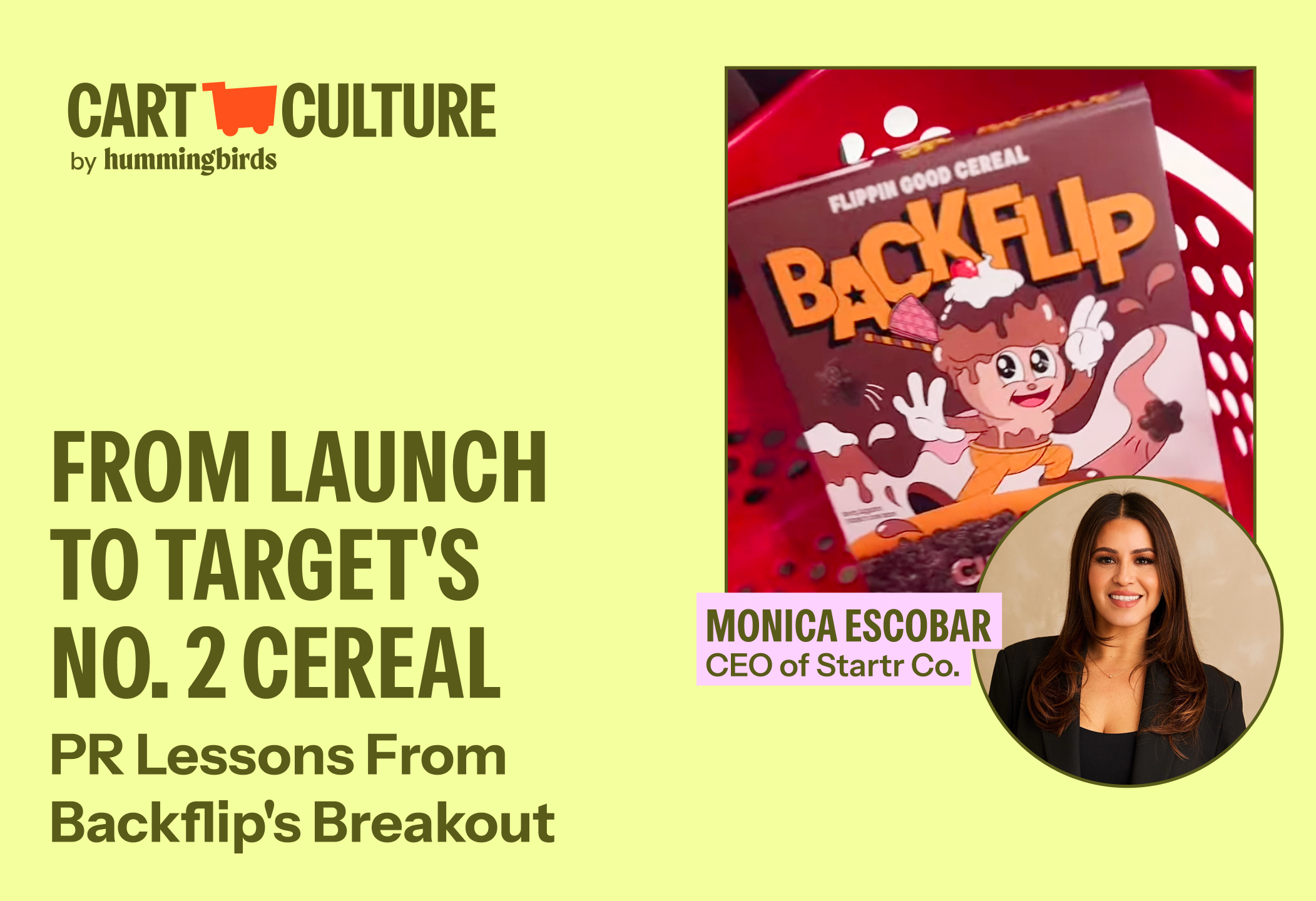
From Launch to Target’s No. 2 Cereal: PR Lessons From Backflip’s Breakout
Proof at the Buyer Meeting Gets Stronger When Retail Data Reaches Your PR Team
- Backflip’s Target buyer shared on stage that the brand was number one in all of breakfast at Target only a month or so after launch, and Startr Co. turned that moment into an Inc. feature 13 days later.
- Monica Guzman Escobar calls it a miss when retailer information is not connected to the PR program, because a unique retail data point can carry a much larger brand story.
- New press should go straight to the sales team so they can use it in meetings with buyers and retailers to support the next distribution conversation.
Competing in a Declining Category Starts With a Story That Has Real Tension
- Cereal has been declining as a category, which gave Backflip’s breakout a natural tension that media wanted to cover.
- Emily Steele shared that 75% of Backflip shoppers are new to the cereal aisle, a signal Monica called a retailer dream because it brings shoppers into more areas of the store.
- A creator cofounder helps only with an authentic, engaged fit, and Monica’s rule is that creators and celebrities should never become the brand.
Always-On Visibility Belongs in Your 2027 Plan, Not Just Your Launch Calendar
- Product coverage usually comes first, while national business features tend to arrive closer to the one-year mark, and Painterland Sisters earned a full Today Show feature after about two years.
- For a launch or retail reset, Monica recommends starting with a PR partner at least one month in advance so coverage lands inside the reset window.
- Startr Co. pursues press for two audiences at once, because what a millennial mom wants to read is not what a buyer wants to read.
In the Age of AI, Shoppers Discover Brands Through Credible Sources and Real Voices
- AI tools pull recommendations from credible sources such as product reviews, third-party content, and national media, so earned coverage keeps working long after it publishes.
- Monica urges brands to integrate AEO and GEO into their entire marketing plan rather than treating them as a separate PR task.
- Earned media also strengthens creator programs, and Emily sees much higher creator opt-ins for brands that already have coverage or a solid social presence.
Welcome to Cart Culture: Meet Monica Guzman Escobar of Startr Co.
What Cart Culture Is About
0:31 – 3:53Emily Steele: Welcome, everyone. We want this to feel like a conversation and a community, so please introduce yourselves in the chat and share what you are excited to hear from Monica. I will be watching the chat and pulling your questions into the conversation as we go. Today we are talking about all things PR, and Backflip is a great story that prompted this opportunity to dig into their success and what Monica was able to jump on for them.
Emily: For about the last year, Cart Culture has focused on conversations that help us understand what gets the consumer to buy and what inspires action at the cart. I love consumer behavior and figuring out the trends, strategies, and winning brands that drive cart behavior in retail specifically. If we have not met yet, I am Emily, cofounder and CEO of Hummingbirds, and I am a passionate community builder who loves community marketing, creator marketing, and the power of word of mouth. Creating Hummingbirds four or five years ago was really about proving that word-of-mouth marketing can be something scalable that brands can tap into.
Emily: We have supported hundreds of CPG brands and built a community of creators who are excited to go into the retail locations where a product is sold, bring it home, and show how they use it and what they recommend. That content inspires people to discover a product and then go try it. Today, Monica will talk about what an always-on PR strategy looks like and how to recognize the lightning-strike moments when it is time to move with urgency.
Meet Monica Guzman Escobar, CEO of Startr Co.
3:53 – 5:11Monica Guzman Escobar: Thank you, Emily. I am Monica Guzman Escobar, CEO of Startr Co. I have been in PR for more than 20 years, and this is our 10-year anniversary at Startr Co. Before Startr Co., I worked with brands like Cheerios, Got Milk?, Nike, Delta, and Heineken on both English- and Spanish-language campaigns. Today we are a CPG-focused agency, and we love working with food brands, pet brands, and family and kids brands.
Monica: We see our role as an extension of our clients, bringing them bold ideas that help them break through all the clutter and noise. We believe that building a brand that endures, one people actually seek out rather than buy once, requires telling stories that resonate and show how your products meet a real consumer need. We get to work with really fun brands, and one of them is Backflip.
How Backflip Turned a Target Buyer’s Data Into an Inc. Feature in 13 Days
A Target Buyer’s Stage Moment Becomes a PR Opportunity
5:11 – 7:33Emily: Since we teed this whole conversation up around Backflip, can you share a little about the brand and what led to the story written about them?
Monica: Backflip is a cereal brand created by Shaun Neff and Ben Azelart, a content creator who cofounded the brand. They launched at Target nationwide, which is a huge feat in and of itself. Shortly after launch, they were on a panel with their Target buyer, and the buyer shared live on stage that Backflip was performing number one in all of breakfast at Target. For a brand that had only been around for about a month to a month and a half, that was crazy news.
Monica: The next day, Shaun texted me to ask whether this was something to talk about from a PR standpoint. I was grabbing lunch near our office, so I literally sat down on a couch in a Banana Republic to take the call. My first question was whether the Target buyer was comfortable with the information being shared, because I first and foremost want to respect the retail relationship. Shaun said he would double-check, although the buyer had shared it publicly on stage. If the buyer was comfortable, I told him it was definitely a story. A new brand outperforming everyone in breakfast so soon after launch is atypical, and having the buyer’s data to co-sign it shows this is not speculation. It shows major momentum and a major need being filled.
From a Text Message to an Inc. Feature in 13 Days
7:33 – 10:14Monica: Next, we got Backflip’s CEO, Matt, on the line. I was actually out of office at the US Open, so I pulled over to take that call, and they decided to move forward. The Monday after Labor Day, our full team got on the phone with them and gathered everything we needed. We had worked with Shaun on a previous brand launch, so we already had relationships and contacts, and we immediately started reaching out to our friendlies. Within two days of outreach, we had an opportunity from Inc. It was originally for a different story where Shaun would contribute a piece, but we insisted on getting the reporter on the phone with Shaun. He is so passionate and intelligent about CPG, and he worked his magic.
“From the moment that I got that text from Shaun … to the moment that first Inc. feature came out was 13 days.”Monica Guzman Escobar, CEO, Startr Co. · 8:25
Monica: We ended up securing two Inc. pieces for the Target story. It was a great combination of Backflip having an incredible story to tell, having the data to back it up, and our team acting strategically and quickly with the relationships to make it all happen. I will also say that getting an Inc. feature 13 days after starting PR work is definitely not typical.
Emily: Were they learning about that data on the panel for the first time?
Monica: Yes. I give so much credit to Shaun, because he has founded so many successful brands and he understands the power of PR. He did not let a day go by. He and Matt saw the opportunity in the moment and were nimble enough to say, “Let’s try, let’s go now.”
Why Data and Tension Make a Story Media Wants to Tell
10:14 – 13:21Emily: How much did the numbers alone help this story land?
Monica: Numbers will always make a story stronger. Media loves data and metrics that show something is real, because it is not just a brand thinking it is great. It is other people co-signing that a need is being filled. This story also had natural tension: cereal has been declining as a category, and Backflip came in and led not only within cereal but within all of breakfast at a retailer like Target. Add a beautifully designed, intentional brand and two amazing cofounders, and there were too many good points to ignore. Once our team found the right outlets and reporters and teed the story up with the right information, it became a home run.
Emily: My notes show that 75% of Backflip shoppers are new to the cereal aisle, which blew my mind as someone who grew up on cereal. How does a data point like that shape the storytelling?
Monica: A data point like that is huge because it shows the unmet need Backflip is filling. It is a retailer dream, because the brand is getting consumers to shop in more areas of the store. As publicists, we naturally do not have access to that information, although some clients are really good about sharing it. It is a miss in some campaigns when retailer information is not connected to the PR program. You will not always get a story about how you are doing at retail, but sometimes there is something unique enough to stand on its own and tell a larger piece of the story. Here, it shows Backflip is clearly doing something right to draw consumers into an aisle they would never have shopped previously.
Creator Cofounders Help, but They Should Never Become the Brand
13:21 – 15:48Emily: Backflip was cofounded by a creator. How do creator-led brands change the PR playbook, if they change it at all?
Monica: Having a creator on board can be a super powerful tool, but it has to be the right person, an authentic fit, and someone who wants to be involved and engaged. Without those things, a creator does not inherently add to the campaign, and a charismatic, involved founder who is not a creator can end up being stronger. The creator also cannot be oversaturated with so many endorsements that it is clear they are not concretely standing for anything. In Backflip’s case, Ben has a very strong and engaged following, Backflip resonated strongly with his audience, and he was committed, made himself available for PR, and was genuinely passionate when he talked about the brand.
Monica: I always say that creators or celebrities who are part of a brand should not become the brand. The brand and the product need to stand on their own and be amazing. Creators are still very powerful tools for specific moments in time when they add significant value and credibility.
Emily: Celebrity endorsements used to be so big, but when the same celebrity endorses everything, it loses credibility. A creator who is focused on one or a few initiatives they are truly passionate about builds so much more trust.
Building an Always-On PR Strategy That Earns Bigger Stories
Always-On PR Versus a Short Sprint
15:48 – 18:27Emily: Tell me about the always-on PR playbook and how key moments, like a revenue milestone or a new hire, add to it. Let’s start from the lens of someone who has never worked with a PR firm.
Monica: As a publicist, I naturally believe PR should always be on. PR works best as a long-term strategy that you can plan and execute for a year, because you see the campaign build on itself and your visibility grow in new and different places. That said, a launch or a very specific activation is a key moment where shorter-term PR can work well because it is anchored in something specific. If you want three months of PR but nothing is happening in those three months, it is hard to say why that window is special.
Monica: Whether you work with an agency, a freelancer, or someone in-house, they should map out the moments when something bigger is happening based on your seasonality, your category, and your marketing calendar. Great publicists always have a story to tell, even when there is no launch or key moment, because most brands cannot launch something or run a huge activation every month. Good PR finds the cultural resonance, timeliness, and relevance in a brand and showcases it at the right moments. For clients with a lot going on, we help them prioritize what will land best and get the most out of their PR investment. Overall, PR is a long-term marketing solution, but a blitz or sprint around a key moment can also pay off in really big ways.
What Happens Around the One-Year Mark
18:27 – 23:23Emily: In our own PR work at Hummingbirds, it took three to six months to feel momentum, because you are building relationships with reporters and building brand awareness. Some people jump in and ask why they are not on the cover of Forbes yet. What happens around the one-year mark?
Monica: A feature with 100% share of voice about your brand, business, and vision is really hard to land in a short period of time. It requires us to dig into your data and metrics, and it requires a foundation of other press. Someone from Inc., Forbes, Entrepreneur, Bloomberg, or the Today Show is not necessarily going to do a full feature if they Google you and find no other press. Press acts as credibility building, so that when big opportunities come, media feels the large story is an investment worth making.
Product coverage
Comes first, because the product has to be validated before anything else.
Industry and trade stories
Put founders and brands in front of buyers and retailers earlier.
National business features
Tend to arrive closer to the one-year mark, once credibility is built.
Monica: When we start with a client, product coverage usually comes first, especially if the brand has not invested in PR before, because the product needs to be validated. We also do a lot of industry storytelling, because trade and industry media put clients in front of buyers and retailers and open earlier founder and brand storytelling opportunities. National business stories tend to come closer to the year mark. Our client Painterland Sisters has been with us for about two years, and in September we landed them on the Today Show’s “She Made It” segment, a full broadcast feature of about five minutes on their business. That was a holy grail, and since then they have had a Forbes piece and an Inc. piece.
Monica: Timing can also depend on what you have going on, since a big fundraise or a major new investor can bring those stories sooner. In our agency history, we once landed a client on the Today Show broadcast within month one, and we told them it was not normal. Press takes time to build, and lead times, approvals, and interviews mean that even a story a reporter loves today rarely publishes immediately.
Emily: It is a test of patience. When a reporter Googles you and finds nothing, giving you a big story is a bet, so founders and marketing teams need to look at their own story as objectively as possible.
Bringing PR Into the Creative Process Early
23:23 – 25:43Emily: An attendee asked how you work with creative and media agencies to keep a campaign story cohesive and aligned on big swings.
Monica: We 100% prefer to work closely with creative agencies early on. Sometimes a creative agency partner develops an initial set of ideas, and we collaborate before anything is presented to the client. We usually love the ideas, and the question is which ones have the best PR legs, because clients benefit most from multifaceted ideas that feed many marketing objectives. If a client invests in a huge creative idea, we want to extend its life and power through PR. Right now, we are doing a lot of 2027 planning with creative agencies so we can present ideas that win across digital, influencer, PR, and in-person events and activations. Whether the partner is an internal team or an external agency, we want to be connected so we can suggest and execute what works in the best interest of the brand.
What Brands Need to Bring to a PR Partnership
25:43 – 28:35Emily: What do founders and marketing teams need to be prepared for when working with a PR team?
Monica: It helps to have one point of contact who can give the green light and share information. When decision-making is all over the place, things stall and you can lose momentum. The product also has to be great, and you have to be clear on who you are as a brand, what you are, and what you are not, because internal confusion about who you serve makes it really hard for us to communicate clearly. Being upfront about budgets helps us know what to suggest and where your best avenues of success are.
Monica: Trust matters, too. Some clients have put their heart and soul into the company and want to micromanage every piece, even though they are not publicists. If you bring on experts to help you scale, you have to trust those experts enough to hear their recommendations and give them room to run. That does not mean letting them run amok, because it has to be collaborative. If the client is not successful, that ultimately reflects badly on us, too.
How Startr Co. Sets PR KPIs
28:35 – 31:29Emily: An attendee asked what metrics you use to quantify a successful PR campaign.
Monica: KPIs differ per brand, and we create them in collaboration with the client. We look at what their previous year looked like, how much and what kinds of press they get as a baseline, and what their marketing calendar holds, including whether there will be lots of announcements or whether we will need to create more news ourselves. We also consider the strength of our relationships and what we have done for other brands in the category. Earned media, which is most of what we deliver, is never guaranteed, but our baseline reflects 10 years as an agency.
Monica: We then build metrics around the client’s business objectives, which might include national consumer media and business press, and we always include trade and industry media for brands looking to grow. Some clients also want affiliate placements that include a specific link for purchase. We report in real time so clients can always see how we are tracking, and we readjust if we surpass the goals early. For long-term clients like GHOST and 7 Sundays, we optimize KPIs based on the previous year so the campaign keeps elevating, growing awareness, and reaching new types of media with new stories.
Want Real Shoppers Finding Your Brand Where They Buy? Let's Talk.
Paid vs. Earned, Retail Resets, AI Discovery & Press That Wins Shelf Space
When a Paid Placement Makes Strategic Sense
31:29 – 34:31Emily: PR is changing. Journalism is evolving, there are so many Substacks now, and a lot of media is pay to play. How do you navigate an amazing audience that costs $20,000 to reach?
Monica: Our team is educated on the many types of paid placements, and some are ridiculously expensive. Others are strategic. In earned media, reporters ultimately cover you with their own lens, so if a client has a critical business priority and wants a message out exactly their way, I might suggest a paid placement. Paid also helps in categories where earned lead times run long. With supplements, interested reporters often want to try the product for about two months before covering it, so a smaller paid placement can bring press out sooner while earned pieces develop. Overall, about 90% of the work we do for clients is earned, and we sprinkle in paid where it makes sense.
Keeping Momentum After a Big Feature
34:31 – 37:33Emily: A week after an article like the Inc. feature, what should a brand do to keep riding the wave?
Monica: As soon as a piece comes out, clients should share it on all their social channels, including LinkedIn, and with their sales team. We want the sales team using the press in their meetings with buyers and retailers to show how successful the brand is at retail and help other conversations along. A good agency partner will also have other stories teed up to continue the momentum. This is where our AEO and GEO strategy matters, because we optimize everything we do for AI visibility. We want a big piece like that to keep feeding Claude, ChatGPT, and other AI recommendations and summaries for a long time, along with all the press that follows.
Monica: Some remarkable brands earn organic press early without an agency, but the challenge is that a great piece can be followed by six quiet months if you are not actively working on PR. One piece of press can do a lot, but the real power comes from doing PR long-term. Some clients who cannot budget for a full year work with us for nine months of every year to cover their key season, which is really smart.
- Quality: Coverage lands in notable, top-tier, trusted outlets and carries the brand’s value proposition and key messaging.
- Consistency: Pieces come out regularly instead of in one burst.
- Volume: There is enough press to build the brand month over month, so people keep hearing from it in new and interesting ways.
Plan PR at Least a Month Before a Launch or Reset
37:33 – 39:13Emily: Do you have timing advice around retail resets, new doors, or new SKUs?
Monica: Media lead times are out of our control, and food and beverage media in particular usually wants to try the product, so there is a lead-up period. If you want to work with a partner around a launch or a reset, begin at least a month in advance. That month covers only the earned media piece. A larger content seeding program or an activation needs to start even earlier. The goal is for press to start coming out right at launch or within the reset window and continue afterward.
How AI Answers Extend the Life of Earned Media
39:13 – 41:25Emily: Can you walk people through how AI and earned media work together?
Monica: It has been a remarkable turn of events for our work. We always knew online coverage keeps working long after it publishes, and AI has made that even more true. AI is changing the way consumers discover brands. Someone can ask for the best snacks for kids or the best cereal, and the AI recommendation might be how they answer that question. AI pulls its recommendations from credible sources, including product reviews, websites, third-party content, and trusted national media outlets. That extends the life of all our coverage and gives it a second avenue. Even if someone never reads Wirecutter, an AI answer about the best laundry detergent can still pull from that Wirecutter article, so press keeps influencing people beyond its initial reach long after it is published.
“The pieces of press are influencing beyond their initial reach and can continue doing so long after pieces are actually published.”Monica Guzman Escobar, CEO, Startr Co. · 40:35
Emily: I did not see that coming, in the best way possible. It is a huge value-add to extend how people search and discover through these LLMs.
Setting a Realistic PR Budget
41:25 – 44:36Emily: Everyone wants to know about budgeting for PR. What do you typically advise emerging brands?
Monica: Pricing for PR is all over the place. Some brands come to me a little early, maybe before they have nationwide distribution, and I applaud them for starting on brand awareness. At that stage, I might refer them to a freelancer who charges a couple thousand dollars a month, which can get the PR wheel going. At the other end, the really big companies pay hundreds of thousands of dollars a month, with a slew of options in between. The biggest, fanciest option is not always the best for you. What you pay for with an agency is the team’s time, so expectations need to align with how far your budget can go.
Emily: At Hummingbirds, we expanded from Des Moines to the Midwest, then Texas, then the coasts, and national coverage did not make sense early on. Regional press played a key role, and we spent about a year with a PR freelancer focused only on CPG trade, because we wanted every CPG brand to know about us. Define the win first, and then ask whether the dollars invested make sense against the KPIs.
Writing for the Shopper and the Buyer
44:36 – 47:47Emily: An attendee asked whether a really good piece of press helps brands earn more distribution and shelf space when they bring it to buyers.
Monica: Most of our clients are actively expanding distribution, and the press helps them do that. Sometimes we announce distribution, and clients take that press to other buyers to land even more stores. The product still has to sell through and do well on shelf, and many other factors contribute to expanded distribution. When distribution is an objective, we are strategic about the press we pursue. A brand’s core audience might be millennial moms, but what is interesting to a millennial mom to read is probably not what is interesting to the buyer to read. We pursue both types of press because these are two different customers of the brand, and we want both to see the brand in the places they read, watch, and listen. A lot of our creative ideation is also built around retail to strengthen those relationships.
Emily: Do brands with existing media relationships have an advantage over other emerging brands?
Monica: Some clients are really PR savvy and share their existing relationships upfront. We manage and tend to those, and our job is to add to them by going after everybody else. Shaun already had great media relationships from his many brands, so we could tap his friendlies and then focus on the other press where we add real value.
Make AEO Part of Everything Your Brand Does
47:47 – 49:27Emily: What do you want people to walk away with today?
Monica: On the AI front, AEO and GEO should be integrated into a brand’s overall marketing plan, not treated as something that only happens in PR. PR makes it more real and tangible, but brands also need to apply it to their positioning, their website, and their own channels. Paired with the right PR strategy, that maximizes the brand’s opportunity to be seen in AI channels. We are piloting a new type of reporting that rolls out next year to measure AI visibility for our clients.
How PR and Creators Feed Each Other, Plus What’s Next
How Earned Media and Creator Content Feed Each Other
49:27 – 54:12Emily: Backflip is one of our customers and also your client. How do you advise clients on influencer strategy?
Monica: We do some influencer marketing focused on strategic partnerships, honing in on the people who can make an impact rather than chasing volume. PR builds credibility, trust, and third-party validation, and content creators make that tangible by showing the real-life use case in a relatable, authentic way. The right creators have engaged audiences who believe them like a friend giving a recommendation. Reading something in the New York Times earns respect, but it can feel less real than seeing someone use a product in real time. Some clients invest in influencer and content creator work ongoing, while others invest around a specific initiative, like a retail rollout where they come to Hummingbirds to get people talking about them at Target or Walmart.
Monica: The earned media foundation also strengthens the work in the creator space. When creators Google a brand and find coverage, they feel confident working with it. When they find nothing, they may still work with the brand but charge more, because they know less about it.
Emily: I cannot underscore that enough. When brands already have a reputation, enough coverage, or even a solid social presence, we see so much higher opt-ins than for brands creators have never seen before. Nobody wants to be the first person in their friend group to talk about something unknown, so brands should be honest about where they stand in the consumer’s mind across earned and social before deciding where creators can make the biggest impact.
Monica: It also works in the other direction. We tell clients we want to know what they are seeing in their DMs and from creators, because that can feed our storytelling. One toy client’s children’s game started showing up in creator content as a decision-making tool for adult couples, like choosing where to go for dinner. It became so powerful that we started pitching it and ran with it on the creator side. When the content side and the earned media side speak to each other, you get the most out of both.
What Set Backflip Up for Its Breakout Moment
54:12 – 56:46Emily: What allowed Backflip to earn that moment on the panel? Hummingbirds was one of their swings, but the strategy was clearly multifaceted.
Monica: They were very smart about the product and the brand they wanted to create before they brought on any partner or went to Target. They understood their category, the white space, and how to enter in a strong way. They have two power cofounders, one who has built a ton of CPG brands and another with a deeply engaged, authentic audience. Their packaging includes a trading card collection with a nostalgic approach, and nostalgia is off the charts right now. They had the good tension of a declining category, a product that speaks for itself, and smart choices in partners, including Hummingbirds and Startr Co.
Monica: Not every brand can do this at the same scale or budget, but the approach can be similar at a smaller scale. Brands can do a lot on their own to set themselves up for success before working with partners. Incorporating AEO and GEO from the onset will be very powerful once you bring partners on, and knowing when to say yes, move quickly, and pull the lever is huge.
Always-On Creator Storytelling and What’s Next
56:47 – 60:34Emily: When we think about PR being always on, we think about creators at Hummingbirds the same way. The creator economy is newer, but the story you tell through creators should align with your PR and your marketing channels to create one cohesive experience. Thank you so much, Monica.
Monica: We are Startr Co., spelled without the “e.” Thank you for having me, Emily.
Emily: With Backflip in Target, our creator campaigns followed three angles: a “Meet Backflip” intro story, a back-to-school moment, and a new flavor announcement. That is an always-on strategy, where creators talk about the brand from a different perspective each time while the story stays cohesive. Many birds, which is what we call our creators, expressed interest, and we treat birds expressing interest as a leading indicator of how creators see a brand. A great story and the work Monica’s team has done give creators a reason to trust the brand and want to be part of it.
Emily: We are also launching our Retail Creator Playbook, which covers what to include in your 2027 plan based on thousands of campaigns with hundreds of brands. We will send the notes and the replay by email, so please forward the replay and help us spread Monica’s expertise as far as we can.
Questions Brand Leaders Asked
How long does it take for PR to land a national business feature for a CPG brand?
According to Monica Guzman Escobar, CEO of Startr Co., product coverage usually comes first, followed by trade and industry storytelling. Full national business features tend to arrive closer to the one-year mark, because outlets like Inc., Forbes, and the Today Show look for a foundation of existing press before investing in a large story. Startr Co. client Painterland Sisters earned a full Today Show feature after about two years.
How far in advance of a retail launch or reset should a CPG brand start PR?
Monica Guzman Escobar recommends starting with a PR partner at least one month before a launch or retail reset for earned media alone. Content seeding programs and activations need to start even earlier. The goal is for press to begin right at launch or within the reset window and continue afterward.
Does PR help CPG brands win more distribution and shelf space?
Yes, PR helps, although the product still has to sell through and perform on shelf. Startr Co. clients take coverage, including distribution announcements, to other buyers to win more stores. Monica Guzman Escobar pursues consumer press and buyer-focused press at the same time, because what interests a millennial mom is rarely what interests a buyer.
How does earned media affect AI recommendations for CPG brands?
AI tools pull their recommendations from credible sources, including product reviews, websites, third-party content, and trusted national media outlets. That means earned coverage keeps influencing shoppers long after it publishes, even for people who never read the original outlet. Monica Guzman Escobar advises brands to integrate AEO and GEO into their entire marketing plan, not only into PR.
How much should an emerging CPG brand budget for PR?
PR pricing varies widely. Monica Guzman Escobar says a brand without nationwide distribution may start with a freelancer at a couple thousand dollars a month, while the largest companies spend hundreds of thousands of dollars a month. Because a brand is paying for a team’s time, expectations should align with what the budget can realistically cover.
Should a creator cofounder be the face of a CPG brand’s PR?
A creator cofounder can be a powerful PR asset when the fit is authentic, the creator is engaged and available, and the creator is not oversaturated with endorsements. Monica Guzman Escobar’s rule is that creators and celebrities should never become the brand, because the brand and the product need to stand on their own.