
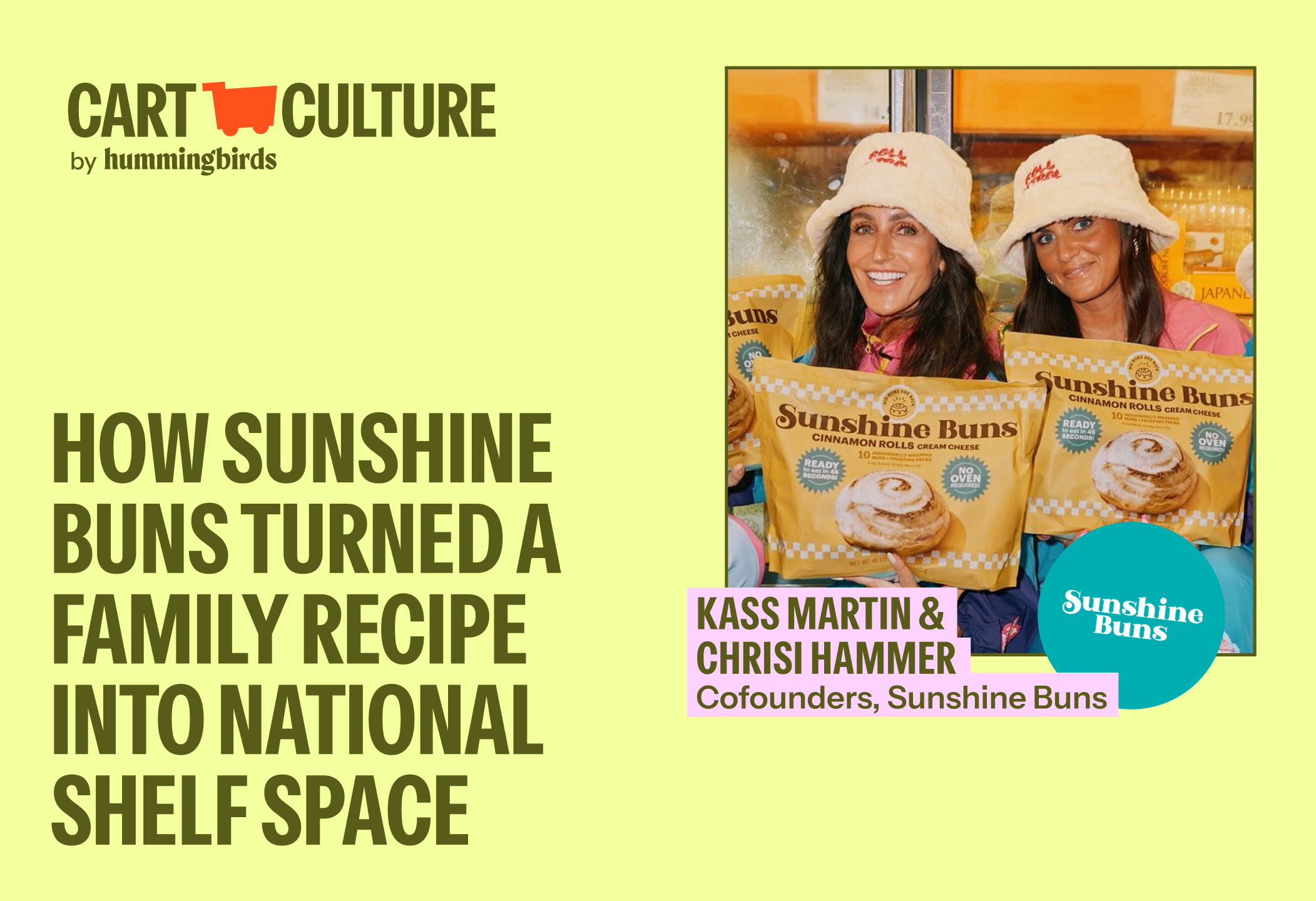
From Family Recipe to Target: How Sunshine Buns Built Retail Velocity
Winning a Familiar Category Starts With a Real Product Gap
- Cinnamon rolls need almost no shopper education, so Sunshine Buns competes on what the category gets wrong: shelf-stable rolls that taste commercial and full of chemicals, or deli rolls that are overbaked.
- Going frozen protected a 1970s family recipe, because the freezer aisle is one of life's greatest natural preservatives, and the finished roll heats and eats in 45 seconds with no baking required.
- Proof came before retail. Sunshine Buns ranked highest in a university food science taste test against brands that have been on shelf for decades.
Packaging Has to Win the Shopper and Fit the Buyer's Freezer Set
- Every SKU gets its own colorway and personality rather than one uniform template, so the line stands out in a sea of standard yellow boxes.
- Design cues span generations, from gingham reworked to lean Gen Z to millennial scalloped edges and a callout to Mema on the back.
- Buyer feedback drove a vertical format built for limited freezer shelf space, filtered through the brand's pillars rather than applied wholesale.
Retail Velocity Is the Pillar Every Other Decision Rests On
- The cofounders call units per store per week their strongest pillar. In their words, “If you're not moving off the shelf, you're dead.”
- Ahead of a national WinCo launch, the team brought on Hummingbirds to reach shoppers outside its Utah backyard and create meaningful lift on units per store per week.
- Concrete modeling drives the retail roadmap, including saying no to two large retailers and building strong regional partners before national chains.
Regional Awareness Comes From Real People, Not More Ads
- Sunshine Buns believes no banner, post, or flyer is more powerful than word of mouth from somebody you trust, a conviction that matters more as AI-generated content fills the feed.
- Creator campaigns with Hummingbirds give real people the freedom to tell the story authentically, which the cofounders say resonates with their brand.
- Regional activations, from Dallas demos to a Times Square billboard pulled together in 21 days, meet shoppers where they are.
Welcome to Cart Culture: From Mema's Kitchen to the Freezer Aisle
0:42 – 2:21Charise Flynn: We're so excited to have Sunshine Buns with us this morning, and they're wearing their great gear. Give us the story on the jackets.
Sunshine Buns: Today we are bun baddies, closing deals on Wall Street in our suits and ties. We're putting up a billboard in Times Square for a large national influencer event we're hosting in New York in two weeks, so we pulled together a photo shoot with all of our bun babes. We went full 80s and 90s corporate, Wolf of Wall Street meets CPG, and it will run on the Times Square billboard. We have a whole other outfit for the event itself. One of the most fun things about being founders is getting to wear what you want and fully buy into your own branding.
2:22 – 4:31Charise: You do an incredible job with your branding and really standing out. Expo was probably the first time I met both of you, and I remember thinking, this brand is on fire. I'm Charise Flynn, one of the cofounders of Hummingbirds. My cofounder Emily usually leads Cart Culture, so I'm excited to step in today, because I love talking with our customers and amplifying the stories of the CPG brands we work with. The timing couldn't be better, either. Sunshine Buns just launched in Target, so this is a huge celebratory moment.
For those of you new to Cart Culture, this is our way at Hummingbirds to share the behind-the-scenes look at the real forces shaping what's working in CPG, what's not, and how brands are ultimately winning in retail. Brands tell us over and over that they love to learn from each other, so our goal is to bring leading voices together on what's new, what's next, and what's noteworthy. Personally, I love helping brands solve problems. Since I was 13, I've been the back-of-the-napkin-math person: if you want a certain revenue number, how do you get there, and what are the problems to solve? I love thinking about scale and hypergrowth, so getting to work with so many hypergrowth CPG brands, alongside creators with authentic, everyday voices who are the power behind how brands scale, has me having the time of my life.
4:34 – 5:04Charise: For anyone new to Hummingbirds, we built the company to help CPG brands drive real-world discovery and create momentum through the everyday voice. Word of mouth is one of the oldest forms of marketing. Hundreds, probably thousands, of years ago, people learned about things through their friends and the people they knew. We get to do that in a modern way and amplify it with technology.
5:06 – 6:36Charise: A big shout out to Kass and Chrisi, who launched nationwide at Target this week. We'll talk about what it took to get the yes, and what the journey looked like to show up successfully at that scale. Today we're diving into how heritage is a differentiator for Sunshine Buns, how you've nailed packaging, which is really the first sales mechanism, how to get retail buyers to say yes, and how to turn the local buzz you started with into the retail proof that helped Sunshine Buns get into Target.
6:40 – 7:47Kass Martin: I'm Kass Martin, cofounder of Sunshine Buns. I'm definitely a yes girl, and I put a lot of energy and hype into whatever I'm doing. Sunshine Buns has been such a fun brand to be a part of, with an ever-evolving ecosystem of what we provide to our community and through our products. Like all founders, I wear a lot of hats, and every day looks a little different. I'm a mom of three and have been married for 24 years.
Chrisi Hammer: I'm Chrisi Hammer, also a cofounder of Sunshine Buns. I'm a mother of five and have been married for 15 years. Once upon a time I was an interior designer, and I'm shocked at how much I use that background on this side of the business. Really, I'm just passionate about selling things I truly love.
A Family Recipe, a Family Business
8:08 – 9:04Charise: Your husbands are involved in the company too, so it's a family recipe and a family business. Chrisi, for anyone who doesn't know Sunshine Buns yet, give us the one-minute version of how you went from your mom's kitchen more than 40 years ago to the freezer aisle.
Chrisi: Sunshine Buns is a fully baked frozen cinnamon roll that you can heat and eat really quickly, but it started with my mom, who we call Mema, in the 1970s. She perfected the recipe and baked and sold the rolls at community events where I grew up in Southern California. I sold them to my coaches and teachers, and for about a decade I wanted to turn it into a business. I kept asking her, and she kept saying no. Then one fateful night, Kass and I were together, and it cosmically turned into a business right then and there. Now we're nationwide. From Mema to the freezer.
9:05 – 10:38Charise: You two are best friends who started by turning your own kitchens into bakeries. How have you split the work from then to now?
Kass: It's been such a journey. It started as an idea, and we were baking buns and doing daily orders and daily deliveries from our houses. It was absolute madness. I am not a baker. I've been in the fitness industry, so I've been shaking my buns, but I haven't been baking my buns. It's been a matter of asking what the problem is, where the fire is, and how quickly we can find a solution. Chrisi is definitely the visionary. Her business intuition and drive are unmatched, and our husbands and I share the weight and wear multiple hats, because we're a very lean team.
Kass: We wanted a proof of concept first while we tested different flavors and frostings, so we started with our brick-and-mortar store. Franchising was our initial idea, but we quickly realized it wasn't the path. That's where CPG came to life, and it was the first time I'd ever used that acronym in my life.
Standing Out in a Category Every Shopper Already Knows
10:41 – 11:45Charise: We work with a lot of CPG founders who fall into the industry. They have a product they love or a problem they're solving, and suddenly they're figuring out a whole new world. How did you decide Sunshine Buns should be a frozen item?
Chrisi: Originally we thought we'd do dough pucks, which is what shoppers can already find in a tube or bagged in the bread section. My mom kept pressing us that she had specifically formulated the dough to be freezer friendly. She told us we could bake it and freeze it, and it would be as delicious as ever without the proofing and baking. We resisted for a few months, until she said she really just wanted us to try it. Almost instantly, we couldn't believe we'd waited, because this was exactly how it was always meant to be. Manufacturing was a completely different hurdle, and getting to where we are now was really difficult, but the core product and the idea of going frozen came from Mema.
11:45 – 12:14Sunshine Buns: Maintaining the timeless taste and integrity of the recipe mattered most. A lot of cinnamon rolls are packed with preservatives, artificial flavorings, and ingredients you've never heard of so they can stay shelf stable. We were never going to taint Mema's recipe, and the freezer aisle is actually one of life's greatest natural preservatives.
12:24 – 13:06Charise: There's often a gap between where a product starts and where people think it needs to be to get on shelf. I love that you're holding true to the heritage of what the product is supposed to taste like and what the ingredients are supposed to be. Chrisi, cinnamon rolls aren't a new category. We've all been eating them since our grandmothers' kitchens. When you took Sunshine Buns into retail, how did you think about breaking into a category with that much familiarity?
13:09 – 14:46Chrisi: As a consumer, not just as a business owner, I saw a huge hole in the market. Everything available tasted commercial and full of chemicals, or you'd find it in the deli section, and it was very overbaked. I always say I'm spoiled because I grew up with Mema, so everything I eat gets measured against that standard. Where some people might say something is good, I know what truly delicious tastes like, because everything we ate growing up was made from scratch. Nothing processed was lying around the house.
Chrisi: That gave me a real understanding that there was a massive hole in the market: either it's overdone and not good, or it tastes like chemicals. I thought we could have Mema's buns in the grocery store, and I knew I couldn't be the only one who wanted that. We also earned a lot of street cred when we individually wrapped our buns. Shoppers otherwise have to buy a whole package or a tray they have to bake, but sometimes people just want to eat one, so individual wrapping has been a real unlock for us.
14:49 – 15:16Charise: I can really feel the passion behind the product and the ingredients. How do you explain it in one sentence to a shopper or a buyer when you're not there shouting from the rooftops?
Sunshine Buns: This is a traditional family recipe cinnamon roll that you heat and eat in 45 seconds, no baking required, and it still tastes like Mema was in your kitchen baking this morning.
Word of Mouth, Creators & Real People in the Age of AI
15:18 – 16:35Charise: You've built a huge community online. How does the story land differently when people are telling it instead of the brand?
Sunshine Buns: We partner with really great people like Hummingbirds, where we're able to come up with a clever campaign and work closely on developing what it looks like. Early on, you throw a lot of paint at the wall and see what sticks. Now that we've refined who our community is and gotten close with them, we're able to fit organically into their lives. That's what's so great about a cinnamon roll. It isn't only for a woman, a man, or a child. It truly knows no generational bounds, so we can speak to young people, older people, and everyone in between. We've been really intentional about building campaigns while also letting our community show up organically and share what Sunshine Buns means to them, how it helps them, and how it fits into their kids' lives.
Sunshine Buns: That can be a neighbor, a family member, or a person on Instagram, but part of it is showing up authentically and showing all the different ways the product is relevant, convenient, and delicious. We try to show up that way ourselves, and it has a trickle effect of authenticity. We're not stuffy. We're very relatable, and people can find themselves in us, in our brand, and in our founder story. It might look, taste, and feel a little different, but it's a very relatable story for the entrepreneur, the mom, or anyone in 2026.
17:52 – 18:50Charise: I love that you pointed out authenticity and the power of the everyday voice. So many decisions are based on what our friends are doing, serving, bringing to a picnic, or sending with their kids for breakfast. We walk a fine line with brands on how unscripted to make their creator campaigns, and brands are often blown away by the unexpected, because it's truly unique to each person and their why, which can be very different from a scripted why. We also know the power of reusable, on-brand content, so we're constantly thinking about what each campaign is trying to accomplish and making room for both. The authentic voice is really, really important in building trust.
18:50 – 19:19Charise: Think about all the AI garbage on the internet right now. I know I can trust Chrisi, versus some personality that I'm not sure even has taste buds. It's the realness.
Sunshine Buns: I fall for AI all the time! Is this person real, or is this person AI? I love what you said, because there's a lot of freedom for authenticity in how you create the campaigns for your birds, and that resonates very well with our brand.
Packaging for the Shopper and the Buyer, Plus Which Feedback to Take
19:23 – 20:12Charise: Let's dive into packaging, which is not always easy.
Chrisi: We just did our photo shoot, so I have the boxes right here. Even as I show you, our first packaging didn't have a vertical version. It was only horizontal, so we've gone through a lot of iterations.
Charise: Walk us through it. What did you want shoppers to feel standing in the freezer section, several feet away, scanning a lot of different products?
20:14 – 21:12Chrisi: First and foremost, we approach this brand by always questioning the status quo, and that applies to big-box packaging, large brands, and conglomerates. We intentionally chose not to follow the rules, and there was a lot of pushback on our packaging, even from our designer. We purposely chose not to work with an experienced CPG package designer because we wanted it to feel so different. I have a design background, which is a curse and a wonderful thing. I care deeply about details most people don't care about, but I also know that even if you don't care about a detail, you notice it. You just can't articulate it.
21:12 – 22:25Chrisi: Here's a specific example. Our traditional yellow box has a yellow check around it. Our designer, who is amazing, wanted every box to have the yellow check so the whole line fit neatly on a one-pager. I pushed back a lot. I wanted each box to have its own check, its own personality, and its own colorway, not a standard box you'd see anywhere else. That was a case where we said it would be a lot more work and more color, but we choose to stand out. When you approach the frozen section, you're in a sea of standard yellow boxes like Eggo, wonderful brands we love, but I think they've lost a lot of opportunity to have personality. We want shoppers to feel excited and nostalgic every single time they look at our box, and to be drawn to it.
22:25 – 23:03Chrisi: We also intentionally married generations. Our gingham is a throwback to the 1950s, but we purposely made it less traditional so it leans more Gen Z. Our scalloped edges lean more millennial, and we gave a callout to Mema on the back. We wanted it to feel multigenerational, familiar, and so dang cute that you just want it in your house.
Gingham, reworked
A 1950s gingham throwback, purposely made less traditional so it reads fresh to younger shoppers.
Scalloped edges
A softer, playful edge treatment that speaks to millennial shoppers scanning the freezer door.
A callout to Mema
The back of every box credits the woman who perfected the recipe in the 1970s.
Chrisi: We've gone through so many iterations of packaging. We started with brown boxes we bought on Amazon and tied with a yellow bow. We were so excited about our first bags, and then at our first show, the very first person who came to our table offered to tell us everything that was wrong with the bag. We'd put so much heart and soul into that packaging, but he was right. It was too wide and too tall.
Chrisi: You have to think about the consumer, with individually wrapped buns and individual frosting packets that make it easy and convenient, and you also have to think about the buyer, who has very limited shelf space in the freezer. Our old boxes were only horizontal, so we realized we needed a vertical version. If a retailer stacks them vertically, the packaging still needs to be fun and have a great image on it, not the nutrition label or the back of the box. We've learned so much from people suggesting something would work better in a waffle-style box. One thing we're great at is pivoting, staying true to who we are while giving credit to what works for others. We'll say, you may have a point, let me take it back to the table and figure out how to make it relevant for Sunshine Buns.
Two Buckets of Feedback, Handled Two Different Ways
24:41 – 26:46Charise: There are so many thoughts and opinions, and I'm sure every retailer has what works for them. How do you take feedback and decide what to move forward with?
Chrisi: You have to be careful and cautious about what feedback you take. There are two buckets: feedback in general, and feedback from buyers. With feedback in general, I think new brands really struggle, because they take everyone's feedback and apply it. That may work when you're first starting, but as you figure out who you are and what your brand pillars are, people outside your closest inner circle really shouldn't be weighing in. What I suggest is to find one or two people who can serve as true mentors, people who understand what you've done and what you're trying to accomplish in the big picture, rather than asking everybody what they think.
Chrisi: Then there's the retailer bucket, which is critical to your success. If the Target buyer says this isn't going to work in their set, you need to ask how you can make it work in their set. Then you combine that advice with the pillars of your business and what makes you special, and figure out how Sunshine Buns fits that parameter without looking like every other brand. It's very nuanced, and I think emerging brands could serve themselves better by sticking to those two ideologies: mentorship from a few trusted people, and fitting retailer feedback into your brand.
Earning the Retail Yes and Knowing When to Say No
26:46 – 28:49Charise: Let's transition to Target. What did the buyer actually need to see before making room for a new item in a crowded category? How did you get them to say yes?
Sunshine Buns: Some products are just hard to say no to. A cinnamon roll is so classic, so nostalgic, and so delicious that there isn't as much education needed. We're not claiming a hundred added things to make it better for you. We're indulgent, we're sweet, and we're convenient, made for the sweet tooth. Our no's have mostly come from channels like all-natural, where we're not the right product, and we're developing different SKUs to help bridge the two.
Sunshine Buns: We've had great success with a great sales team, a great product, and a willingness to go talk to buyers and share our product with fearless conviction. The first customer you need is yourself. Because we believe in our product so much, we can handle negative feedback more graciously, and buyers can see the passion behind it. They can see it's a truly remarkable product that isn't trying to be something it's not.
28:55 – 30:36Charise: It's that theme of authenticity again, really believing in your own product. We can all relate to products where you think, I don't know if this is ready for retail yet.
Sunshine Buns: When we were first starting, someone who had sold their company for over a billion dollars came to us and asked, “I know you think your product is good, but do other people really think it's good?” We had a brick-and-mortar store, plus friends and family telling us it was delicious, but we ran a taste test at a local university with a full taste-testing department in its food science program. We lined our buns up against well-reviewed local buns and very familiar names that have been on shelf for decades, and we ranked highest in all the most important categories: taste, aftertaste, the amount of cinnamon, the frosting, the dough, how it feels, and how it smells. That study was such a gift early on, because it proved it wasn't just us. This is freaking amazing.
Saying No to Capital and Retailers That Don't Fit
30:47 – 32:22Charise: Product feedback beyond friends and family is so important, because those closest to you might not always give you the real feedback. Let's talk about the power of saying no. Strategy is about what you're going to say no to, not all the things you're going to do. What have you said no to?
Kass: Most recently, we completed a fundraise, and it's been a journey figuring out who will be the long-term financial partner for Sunshine Buns. It was a wildly difficult process, with so many conversations and introductions. Ultimately, we said no to what may have been a dream fund for some, because it didn't align with our values or how we see the vision of the company. We said no to what others might say yes to, because it didn't feel right to us, which takes us back to authenticity.
32:22 – 33:00Kass: As you grow into a more seasoned brand, you get opportunities that just don't make financial sense. When you're first starting, you say yes, yes, yes. As you grow, the P&L is an important paper you always have to track, and in manufacturing you have to ask whether you can handle it logistically. I love to say yes, but there's also a time for no, and we've reached that season. We recently said no to two large retailers because it didn't make sense for us financially. It would have been great top-line revenue, but it didn't make sense for the business.
33:00 – 34:15Charise: It's so important to share these stories. I've heard founders say they don't feel like they have a choice because they need the money. I think of it like a marriage. You would never marry someone you didn't have a good long-term connection with, and investors are no different. They can be super active and super helpful, but without value alignment, they can be super distracting, and you end up managing investors instead of building your business. Kudos for recognizing you have a choice. On the retailer side, we've seen brands say yes too early. When do you say yes, when do you say no, and is it a model or more of a feeling?
34:17 – 35:41Chrisi: At this stage in our business, it's definitely not a feeling. We have very concrete modeling that lets us plug in a scenario and see whether it works. We onboarded with Critical Mass Group, a sales organization we believe is the best in the business, and they've been crucial in guiding those decisions, our pricing architecture, and our route to market. We built a strategy and stuck with it. We were also finally able to hire a VP of Sales who has more experience than all four of us founders, and she can say, this doesn't make sense right now, but let's come back to it in late 2027.
Chrisi: You also have to be intentional about the cadence of who comes on and when. There's one national retailer we're ready for, and another really big national retailer we're not ready for, because they can cannibalize the rest of the country. You have to make sure you're going to market in the correct order, so you don't cannibalize the Central Markets and Lunds & Byerlys of the world. Those are incredibly important retail partners, and the large players can wait while you build relationships with strong regional retailers. That's how we've approached it.
Want Real People Talking About Your Brand in Every Region You Launch? Let's Talk.
Regional Momentum, Live Q&A & What's Next
35:51 – 37:33Charise: Let's start gathering questions in the chat while I ask one last question. You talked about building out regional retailers. How do you build awareness in a region or a new retailer where people don't know who you are yet?
Sunshine Buns: It all goes back to strategy, working with our marketing team and with CMG's rollout strategy. When we approach every buyer, we love to highlight the people who are making our dreams come true. We help with our social media presence, and we have Hummingbirds. Those things are always helping build social awareness, not only of our product but of who we are, and we're gaining traction with that. We're always open to new ideas for building awareness, because it's such an important piece of the puzzle, but CMG, our marketing team, and Hummingbirds together have been our greatest strategies so far.
37:36 – 37:53Charise: People need to see your brand in multiple places, in multiple ways. We call that the halo effect, or the omnichannel effect. Shoppers need to feel like they're seeing Sunshine Buns everywhere, with as many friends as possible talking about it, in one, two, three, four places.
37:54 – 39:19Sunshine Buns: We're back to authenticity and questioning everything, and we truly question everything. When we say we're going to throw an influencer party with media and put up a billboard in Times Square, people ask when, and we say in 21 days. They say it can't be done, and we say it can be done and we will do it. We've given ourselves the freedom to act on moments that are critical for building our community.
Sunshine Buns: We're doing bun tours, and wherever we go, we take on the personality of that region. We just went to Dallas, did demos, and went all in on Dallas. When we go to New York, we do New York, and when we go to LA, we do LA. We're speaking to our people where they are, connecting with influencers where they are and hosting events where they are. It's not about us. It's about how we can fit in with you in LA or New York, so you think, they get New York. It's really a celebration of the regions that make this country so great and build great communities.
39:21 – 40:22Sunshine Buns: We were just at a show in Texas, and while today's jackets say bun baddies, there we were bun slingers. Someone came up and said she'd been wondering about us, because we're the only ones who do things like that, and she's always excited to see what we're wearing and doing. If you're building a brand with your best friend and your husbands, let's make it fun, bright, and bold. Let's have music, be a little irreverent, and bring people together. Someone once told us they love what we're doing because we don't necessarily know the rules, so we don't know that we're breaking them. We love that, because we can show up at a show truer to who we are instead of trying to fit into cookie-cutter parameters, and that has served us so well in building our brand.
40:27 – 40:57Charise: The key takeaways are authenticity, fun, and a regional approach. You have to be where your feet are and know who you're talking to and what's authentic to them. I always love seeing what you're wearing, your booths are always alive, and fun attracts fun.
What Founders and Brand Leaders Asked
40:59 – 41:51Charise: A shout out from the chat: moms get it done! Rebecca asks: I have a family recipe I want to explore and a list of manufacturers to consider. What qualities are important?
Sunshine Buns: This is a big question. More than success, we've had a lot of failure with bad manufacturing, so due diligence can't be slept on. You need to visit, you need to have active conversations, and you can't let them push you around. Be very firm about what you won't yield on because it's true to who you are. If that partner says no, you're going to find someone who will say yes.
42:01 – 43:36Chrisi: I've been to each manufacturing plant many times, and my mom has gone to every plant too. Mema is right there saying what's acceptable, what's unacceptable, and what needs to change. Make sure you have good standard operating procedures and contracts in hand, signed, sealed, and delivered, because you can get into a really sticky situation. We've likely burned $200,000 on bad manufacturing practices, not from us but from them, and with no contract, we just had to walk away.
Chrisi: Do serious due diligence, stand firm, and don't be frustrated by a no. It takes work and some weeding. We also live in the age of AI, so use it to scour the country for manufacturers that fit your parameters. Keep two or three manufacturers on the line, because you may grow very fast, like we are, and you need backup plans so you can bring on plants at the drop of a hat. Think about what 2028 and 2030 look like, and build those relationships well in advance, even if you're not spending money on them yet.
43:38 – 44:36Charise: How do you dig into the culture of each city? What's the Texas feel versus the New York flavor?
Sunshine Buns: So far, the places we've gone for shows have been pretty easy. We run with the iconic look and feel of each city and bring our own Sunshine Buns twist to it. As it gets more ingrained, it'll probably look a little different. Our mascot is a bun, so when we're launching our Southern California stores, we want him to be very SoCal, and for our Northern California stores, we want him to feel more NorCal. That brings a fun, fresh vibe to our marketing.
44:37 – 46:39Charise: Karuna asks: at what point did you bring on Hummingbirds to make sure it was most effective? We talk about this with brands too, because sometimes it might be too early. We're thoughtful about the right timing, so I'd love to hear how you thought about it.
Chrisi: For us, while I talk about pillars and how important they are, the strongest pillar is units per store per week. If you don't know that metric, you'd better learn it, because selling units per store per week is the entirety of your business. If you're not moving off the shelf, you're dead. Early on, we had great opportunities like a national WinCo launch, but we didn't have the digital acumen to understand how we'd reach those shoppers in Texas and Oregon. We were a Utah-based brand, and it was our first national launch, so we asked how we could move those units, because it was imperative that we move them.
Chrisi: Early on, I did a tremendous amount of research. I lived in “what is CPG”: phone calls, conversations, texts, emails, deep dives, YouTube, and Pinterest. So when I met Kelly at Fancy Food in January 2026 and she said she was with Hummingbirds, I had already researched what Hummingbirds did, and I said, let's get them. Let's build this relationship now, so that when we're ready to launch with our first national retailer, we can onboard them.
Charise: The relationship piece is huge, because we're so involved with our customers, and it has to be a great fit on both sides. At the end of the day, people do business with people. That applies to your manufacturer, your broker, and every partner you work with. Do you enjoy working with them? Will they go through the hard things with you? Will they be a strategic partner? In this business, it's more important than ever to build relationships around testing, trial, and iterating with the folks who will do that alongside you.
47:26 – 48:07Charise: A rapid-fire question: what are your thoughts on slotting, and does it factor into decisions about retailers?
Sunshine Buns: Slotting definitely factors in, and we go back to our strategy and what we're trying to accomplish overall. Some retailers are pay-to-play, but a national rollout can deliver enough brand awareness that the slotting cost makes sense once you look at your actual all-in cost. Others, like we were talking about, have slotting that's too high for the timing, because it doesn't give enough lift on our brand to make it worth it.
48:09 – 50:02Charise: Last question. How did you start the business? Did you start from home or go straight to mass production, and how did you fund the company's growth?
Sunshine Buns: We really just started with us in a parking lot. We bought a GoDaddy site for $33 and said that in six days we'd be baking and selling from our homes. Place your order by 2 PM, and we'll deliver it to your house that night. It was really challenging, and it cost both families a lot of money, because we had no financial backing. We leveraged every resource we could and showed up in every possible place with our cinnamon rolls, asking for a chance.
Sunshine Buns: There's no quick answer. You have to give so much of yourself for so many years before you get to this point. People congratulate us on the overnight success, and we've been working on this for four years. When we were selling from Amazon boxes, nobody knew who we were. It takes a long time, so don't be hard on yourself, but be prepared and willing to give every dollar, every resource, and every physical calorie you can spare to truly building a brand if you want a national presence. Give what you can emotionally, too. Holding on to hope is an emotional burden, so it helps to have the decision already made every day, because a lot of people have great ideas and then they just stop. The hurdles you'll face are never-ending, but your conviction is what will bring you through to the finish line.
Charise: Kass, Chrisi, thank you for sharing the ins and outs of the founder journey: the hard decisions, what you say yes and no to, where you hold conviction, and the grit it takes to get from A to B. Next on Cart Culture, we're sitting down with the sister founders of Maazah on Tuesday, November 3 at 11:00 AM. Every Cart Culture focuses on the founder story and how brands are winning in retail, so these stories can help other founders shape their own strategy.
Frequently Asked Questions
How did Sunshine Buns earn a yes from Target in a crowded frozen category?
Sunshine Buns paired a classic, nostalgic product with fearless conviction. Because a cinnamon roll needs very little shopper education, the cofounders focused on a great product, a strong sales team, and a willingness to sit down with buyers and share the product directly. Early proof helped as well. In a taste test run by a local university's food science department, Sunshine Buns ranked highest in taste, aftertaste, cinnamon, frosting, dough, texture, and smell against well-known brands that have been on shelf for decades.
When is the right time for a CPG brand to bring on Hummingbirds?
For Sunshine Buns, the right moment was ahead of its first national retail launch. The cofounders call units per store per week the strongest pillar of any CPG business, and they partnered with Hummingbirds to reach shoppers outside their home market of Utah, in places like Texas and Oregon, where the brand had no local presence. They built the relationship early so Hummingbirds could be onboarded as soon as that first national launch was ready.
Why are Sunshine Buns sold frozen instead of as refrigerated dough?
Mema, the mother of cofounder Chrisi Hammer, perfected the recipe in the 1970s and formulated the dough to be freezer friendly. Fully baking and then freezing the rolls protects the recipe's taste without the preservatives and artificial flavorings that shelf-stable cinnamon rolls rely on. Shoppers can heat and eat a roll in 45 seconds with no proofing or baking required.
How should an emerging CPG brand decide which retailers to say yes to?
Sunshine Buns relies on concrete financial modeling rather than instinct, guided by its sales brokerage, Critical Mass Group, and an experienced VP of Sales. The team weighs slotting costs against the brand awareness a rollout creates, has turned down two large retailers that did not make financial sense, and prioritizes strong regional retailers before national chains that can cannibalize regional markets.
What should a founder look for in a co-manufacturer?
Sunshine Buns recommends serious due diligence. Visit every plant, hold firm on the standards that make your product what it is, and require standard operating procedures and signed contracts before production begins. The cofounders also suggest keeping two or three manufacturers in the pipeline so the brand can add capacity quickly as it grows.
How does Sunshine Buns packaging stand out in the freezer aisle?
Each Sunshine Buns box carries its own colorway and personality instead of one uniform design, and the packaging blends generational cues, including gingham reworked to lean Gen Z, millennial-leaning scalloped edges, and a callout to Mema on the back. The team also added vertical packaging so the front of the box stays eye-catching when retailers stack it in limited freezer space.