
Brand Is a Business Discipline, Not a Design Exercise
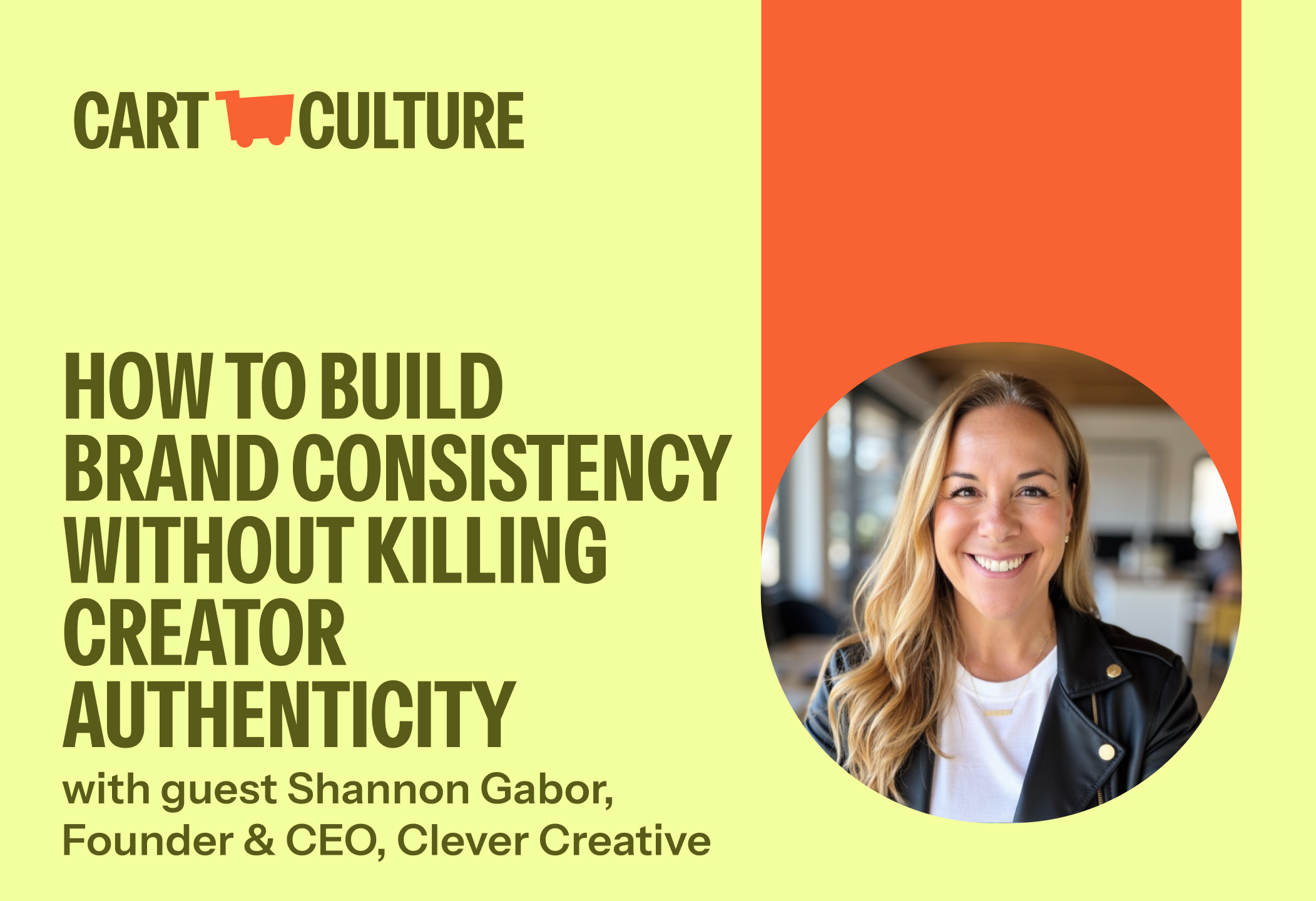
Brand Guardrails Aren't Supposed to Make You Boring. Here's How to Build Ones That Actually Hold Up.
Clever Creative founder Shannon Gabor joins Hummingbirds' Cart Culture to break down how CPG brands build guardrails that hold a brand together across every channel, at every stage of growth, without stripping the authenticity out of the creators and campaigns carrying that brand to shelf.
Your Brand Guardrails Should Fit Your Stage, Not Impress an Agency
- Guardrails are a living tool, not a 50-page brand Bible. Shannon recommends starting with as little as two pages built around your core customer, a real positioning statement, and a tone of voice.
- The non-negotiables before touching a logo file: your customer's reasons to believe, a plain-language positioning statement, and a tone and voice glossary.
- Visual rules only mean something once you show them applied: a logo lockup, a partner co-brand, and how the system holds up on a social image, a package, and a lower-funnel ad, not just on a white background.
Give Creators a Spine, Not a Script
- The strongest guardrails protect voice without handing creators a script: a tone and word-bank glossary, delicious versus craveable, does more for consistency than a locked-down style sheet.
- Campaigns, not core assets, are where a brand can safely go off-brand and experiment. Packaging and the website stay fixed. Social and campaign concepts are the sandbox.
- A real Power Crunch Bar rebrand shows the shift in practice: moving language from performance and strength to simplicity, portability, and great taste to win a new aisle, with no change to the formulation.
Brand Doesn't Get an Instant Scorecard, So Pitch It as a Cost Reduction
- Leadership treats brand as a nice-to-have instead of infrastructure because, unlike performance marketing, it has no instant scorecard. The fix: brand is the reason performance marketing gets cheaper and compounds instead of resetting every campaign.
- A clear, consistent brand lowers acquisition cost over time, because a shopper already trusts what they're clicking before the ad even runs.
- Brands rarely lose their identity in one bad decision. It happens through dozens of small, individually reasonable compromises that nobody flags as a big deal until they add up.
Meet Shannon Gabor: Why Brand Is a Business Discipline, Not a Design Exercise
2:46 – 4:42Emily Steele: Hummingbirds started here in Des Moines, Iowa, and has grown across the country over the last four years, bringing everyday creators into a platform that works with CPG brands in retail. Creators go into stores to create content, share products on shelf, and drive product movement, tracked through attributable share links alongside a full content engine, for more than 400 CPG brands today. I'm obsessed with the moment of discovery, the moment someone decides they need a product, whether that comes from creator content, from the brand itself, or simply from packaging that stops someone in the aisle. That's why Cart Culture exists, and today's conversation is entirely about the brand side of that equation: building brand consistency across every channel, with Shannon Gabor of Clever Creative.
5:16 – 8:58Shannon Gabor: I'm calling in from Los Angeles, and I'm the founder of Clever Creative. I'm originally from New Jersey, and my career started in a traditional agency environment before I went in-house at Mattel as a packaging designer, which is where my love for sculptural, tactile design really took hold. I founded Clever in 2004 as a women-owned independent shop, built at the intersection of design, culture, and consumer behavior. Clever has been in business for 22 years now, working with brands across the entire growth chart, from a founder with just a nugget of an idea to businesses with private equity backing that are scaling fast.
Emily: So regardless of whether someone has the smallest nugget of an idea or is scaling with private equity backing, you come back to brand as a business discipline rather than a design exercise. Can you pull that thread a little more?
Shannon: We're in a moment where brand, marketing, and PR are no longer three separate disciplines handing work to one another. Brand establishes what you want to mean. Marketing creates the demand around that meaning. Comms and PR build the belief, relevance, and reputation around it. The best modern brands are creating a conversation, not just communication, and that makes brand a business function, not only a creative one. That doesn't discredit the craft. I started in packaging, and there's an incredible group of women in my shop who still make things people want to look at, touch, and hold every day. But brand isn't a logo only. It's a system, and it's not just what you look like.
Establishes What You Want to Mean
The foundational layer: what the company stands for and how it wants to be understood.
Creates the Demand
Builds demand around that meaning so the right customer notices and acts.
Builds the Belief
Builds the belief, relevance, and reputation that make the meaning stick.
What “Good Brand” Actually Means to a Shopper
12:35 – 15:15Emily: So when someone says a company has a great brand, what is the average person actually saying?
Shannon: It varies by person, and it can even vary by where someone is in their decision-making process. My daughter has very curly hair, and on a recent college visit her hair products were taken at airport security because she didn't realize they were over the limit. That's a small, personal example of someone relying on a brand for something that works for them, and losing access to it right before she had to show up and meet people for the first time. Brand can mean I rely on this and I panic when it's not there. It can mean it's reliable and it's a family history. We were recently working with Barkeeper's Friend, a brand with real heritage, and I shared my own story about the can that always sat under my grandfather's sink, then got passed to my dad, and now lives under my sink. Brand can also simply mean memory.
15:28 – 19:05Emily: So how do you help someone unpack what they want to be associated with, especially early on?
Shannon: It starts with getting really clear on why you're here. When a founder comes through Clever's door, I tell them honestly that they know more than we do. We're not here to reinvent something or make it into what it was never meant to be. It's already in them. From there we ask who this is actually for, whose cart, shelf, or pantry it's going into, because that's how you find a voice that's genuinely differentiated instead of generic.
What Actually Belongs in a Brand Guardrails Toolkit
Emily: As a founder grows a team, or brings in an agency like Clever, what happens in that growth stage to keep the brand vision consistent?
Shannon: Consistency is a brand knowing what it stands for. The fear is a brand hoping nobody notices what it doesn't stand for, so you have to be comfortable knowing what you are, what you're not, and you have to back that up every time. A brand guidelines document matters no matter the size or scale of the business, but it has to be a living tool, not something that gets created once and gathers dust. It doesn't need to be a 50-page brand Bible. It could be two pages. What matters is that it's tailored to actually be useful and to make whoever's using it feel empowered, not confused.
20:49 – 25:03Shannon: Makers and creatives actually want some rules, because rules are what let wonder and possibility emerge inside real boundaries.
Emily: That's exactly what we hear from creators on our own platform. They love creative autonomy, but they also want to understand what a brand actually wants from them, what parameters they're working inside.
Shannon: Exactly, and that resonates in the creator economy and inside our own company too. As brands begin to scale, the essentials are knowing your customer's core truth and their reasons to believe, then a real positioning statement: the position your brand and product hold, whether you're walking into a buyer meeting or briefing a creator who's about to make content for you. From there, tone and voice matter as much as visuals, and then the visual rules themselves: how the logo shows up, how it shares space with a partner logo, typography, color hierarchy. The guidelines only become real once you show them applied, on a social image, on a package, on a lower-funnel ad, and on a brand awareness campaign, not just on a white background.
Reasons to Believe
Their behavior, and the specific reasons they believe in what you make, before a single guideline gets written.
Positioning Statement
The position your brand and product hold in the market, useful in a buyer meeting and a creator brief alike.
Voice & Word Bank
The specific words you'd use, like delicious, and the ones you wouldn't, like craveable, so tone holds steady even when the writer changes.
A Spine, Not a Script: Protecting Voice Without Killing Creativity
25:08 – 28:14Emily: How do you know when something is starting to feel inconsistent with a brand? What does that look like as it's happening?
Shannon: You don't want to hand someone a script, because then it feels inauthentic no matter how well it's produced. You have to hand them a spine instead, something with power, strength, and clarity, and then let them go. Inconsistency shows up two ways. Sometimes it's visually obvious: the logo in the wrong color, the wrong size, the wrong placement. Other times it's in tone, in the small word choices, like whether something is described as delicious or as craveable. We build a word bank for clients for exactly this reason, a glossary of what you'd say and what you wouldn't, so tone holds together without ever making someone feel like they can't be creative. Guardrails exist so a brand stays recognizable, so a wild ad on a billboard never feels jarring next to what that brand shows up as anywhere else.
Power Crunch Bar: Rewriting Tone for a New Aisle
28:16 – 31:15Shannon: A founder of Power Crunch Bar, a professional bodybuilder who created the formula to help his young son grow, wanted to move his product from the HBA section of a store into snacks. That meant shifting from performance-driven language, strength, energy, competence, into simplicity, ease, portability, and great taste, phrases like elevate the everyday, crunch factor, wafer thin, light on taste, big on flavor. None of that diminished the formulation he was proud of. It just meant the tone had to meet the demands of the new aisle he was moving into and the new person meeting the package there.
31:16 – 33:11Shannon: I'd also recommend studying brands outside your own category. Chime is a financial brand, not CPG, but the name itself is a sound, and that choice does the work of making a genuinely complicated category, personal finance, feel simple and approachable for a specific generation of consumer. It doesn't feel like a Charles Schwab brand. It feels like Chime. Go find brands like that outside your industry, write them down, and study what they're doing differently.
Where to Experiment and Where to Hold the Line
33:26 – 34:16Shannon: One common mistake for a growth-stage brand is optimizing so hard for a single channel that the product stops winning anywhere else. A product has to win in real life, not just under fluorescent lighting, not just next to twenty competitors, and not just with a caption explaining it on social. If your packaging only works with a caption, it doesn't actually work. Think about the context where you want to win, and what needs to be dialed up or down to get there.
34:36 – 38:14Shannon: The parts of a brand that should stay fixed are the core tenets: your website, your packaging. Social can adapt more, based on strategy, some brands chase cultural relevance and trending formats, others don't, and that's fine too. Campaigns are the best place to go off-brand on purpose. It's okay to launch a product and sound a little different for it, get a little sassier, a little more playful, a little more functional, as long as the logo still sits in the right place and the colors still feel familiar. That's not off-brand. That's choosing to talk about a different feature of the brand in a way you haven't before, and it's worth testing what happens to sales when you do.
How Brands Lose Themselves at Scale, and the Business Case for Protecting Them
38:34 – 41:47Emily: How do you find your way back to your brand when you're feeling lost, especially somewhere between one or two employees and fifty?
Shannon: Sometimes it takes personal time and getting quiet with yourself. I've told clients to write a one-page letter to their founder self from ten years ago: why did you wake up and do this, before any of the vision around scale, exits, or growth took over. None of that is bad, we're all business people here trying to make a better living, but it's worth remembering the beauty of what you made in the first place. Sometimes self-reflection is enough. Sometimes it's worth hiring an outside perspective to do a quick audit, because outside perspective is just as valuable as internal reflection.
41:48 – 43:36Emily: It's funny, I can be really myopic about something internally, then get on customer calls where people say they love the outcome, and I realize the world is having a great experience with the brand even when I'm being my own harshest critic.
Shannon: We are always our harshest critics. But a brand rarely loses itself from growth alone. It loses itself from the smallest compromises that felt reasonable in the moment: changing your tone for a bigger retailer, a slightly safer message for a bigger audience, a diluted mission to fit more use cases. None of those individually feels like a betrayal. Growth doesn't kill a brand's identity in one big decision. It's usually fifty small ones that nobody flagged as important. The brands that stay themselves through growth are the ones that keep asking the same question at every size: would we still say this if we were small again?
Pitching Brand Investment to Leadership
46:05 – 49:42Emily: One question that comes up constantly: how do you build a business case for investing in brand when you're trying to convince executive leadership, especially in a B2B context, with an outdated logo, color palette, and type that doesn't fit the business anymore?
Shannon: Performance marketing gets an instant scorecard: a number, data, insights. Brand doesn't get that same instant scorecard, so it's easy for leadership to treat it as a nice-to-have instead of infrastructure. The reframe is that brand is the reason performance marketing gets cheaper and more effective over time. It's not competing with ROI, it's the reason ROI compounds instead of resetting with every campaign. Don't pitch brand as an emotional investment. Pitch it as a cost reduction: a clear, consistent brand lowers acquisition costs over time because trust is already built before an ad even runs. A strong brand system is also an operating system. When a team knows where assets live, what the naming conventions are, and how to use the toolkit, everyone works faster inside their own area of expertise, and that shows up as real time and cost savings, not just a feeling.
Cart Culture: From GoodPop to Hershey, the Framework for Proving Velocity at Every Stage. Kate, now at Hershey, joins to talk through her own path from GoodPop to Hershey.
Want Creators Who Already Protect Your Brand's Spine? Let's Talk.
Live Q&A: What Brand Leaders Asked
How should a brand approach creator content when it doesn't have much brand equity yet?
Start by testing. Content itself can be the means of finding out what's true and memorable about a brand, so try a few different directions and listen closely to how people respond. Before handing someone a microphone to talk about you, though, get clear on why you're differentiated. Asking a creator to represent something without giving them that clarity first is where things get dangerous, because they might take a direction that never fit the brand in the first place.
How do you know it's time for a logo or brand refresh, and how do you stay consistent through the change?
Define the change on a scale before you start, evolution on one end, revolution on the other. Plot where the refresh should land and be honest about why: are you protecting the essence of who you are, or trying to shake things up because competitors are starting to look like you? Writing that down first is what lets whoever you hire actually understand the assignment instead of guessing, and it keeps the rebrand from wasting time or budget. Clever went through its own rebrand years ago and hired an outside designer to do it, because the team was too close to their own brand to see it clearly.
Should the founder be the ultimate caretaker of a brand as a company scales?
It depends on size, but the honest answer is that founders can get in their own way. Founders are deeply connected to what they built, which can mean losing some perspective. At scale, brand caretaking works better as a core leadership team decision, split across roles like a chief revenue officer, chief operating officer, or chief brand officer, with the founder as part of that conversation rather than the sole voice. Everyone on a team comes with a zone of genius, and that's exactly why they were brought on in the first place.